In light of recent events related to immigration enforcement in Minnesota, we canvassed our insights community of suburban swing voters in nine key midterm battleground states1 for their reactions and sentiments. The activity took place from February 3-5, 2026, among 75 participants.
KEY INSIGHTS
Recent events in Minnesota have shifted the conversation from immigration policy principles to enforcement tactics, driven by concerns about preserving human dignity.
There is a preference for companies to remain neutral on immigration enforcement, but context is important; more are supportive if the issue directly impacts the company.
Engaging publicly on immigration enforcement carries substantial risk with minimal upside for reaching persuadable audiences, given the strong preference for corporate neutrality.
Swing voters place immigration behind other concerns.
Only a handful say that immigration is the most important issue facing the U.S. today.
Of those who do find it most important, nearly all worry about the increase in violence and agree it is causing unrest and division – however, some attribute the unrest to resistance to law enforcement, while others say it’s due to ICE itself.
A larger share rank inflation, protecting democracy, jobs and the economy, or taxes and government spending as the most important issue facing the U.S. today.
A handful of Democrat-leaning swing voters and Independents link immigration to broader concerns about the Trump administration’s authoritarian governance and threats to democratic institutions and norms.
“There are so many conflicting ideas on how immigration should be handled and it’s throwing the country into turmoil.” – Republican Swing Voter
“Immigration because of everything that is going on in Minneapolis and other cities with ICE coming in and detaining people and causing so much division and hatred.” – Democrat Swing Voter
“Our government has created a dangerous environment for the citizens.” – Independent Swing Voter
Recent events in Minnesota have heightened humanitarian concerns about immigration enforcement.
55% of swing voters overall say recent events in Minnesota have made them less supportive of current immigration policies.
However, there is a stark partisan divide – 79% of Democrat-leaning swing voters say they feel less supportive of current immigration policies, more than two times Republican-leaning swing voters (39%). Independents lie in the middle at 54%.
A number of different values and priorities play into voters’ views of current immigration enforcement:
Dignity: Many prioritize humanitarian concerns, saying that immigrants should be treated humanely and with respect. Democrats highly value this, saying the government has gone too far and emphasize the need for due process. Some Republicans and Independents concur and say ICE is approaching enforcement the wrong way, acknowledging that ICE has a job to do but their agents are going “rogue” and tactics like profiling and frisking are “not right.”
Rule of Law: Other Republicans firmly believe that the federal government has the authority to enforce immigration law. They say there is a clear path to citizenship; those who illegally immigrated have violated the law and should be deported.
Targeting Priorities: Among Republicans and Independents, there is a tension about who ICE should be targeting – some consider anyone who immigrated illegally to be a criminal who should be deported, while others believe ICE should be much more focused on deporting “true criminals” - those who are in prisons or charged with crimes.
Other Options: Some Republicans say the administration should focus on other approaches to curb illegal immigration altogether, such as securing our borders and making the path to citizenship easier.
“There is a way to enforce the law without cruelty and murder.” – Democrat Swing Voter
“ICE should use other means to enforce immigration. Too much violence has occurred.” – Republican Swing Voter
“We need to get illegal immigrants out of our country. But we also need to make the path to citizenship easier and less expensive so people will want to come here legally.” – Republican Swing Voter
“I have no problem with deporting those that have actually been charged with crimes, but the way it is being handled is that they seem to be just rounding up all immigrants.” – Independent Swing Voter
Few support companies taking public stances on immigration enforcement.
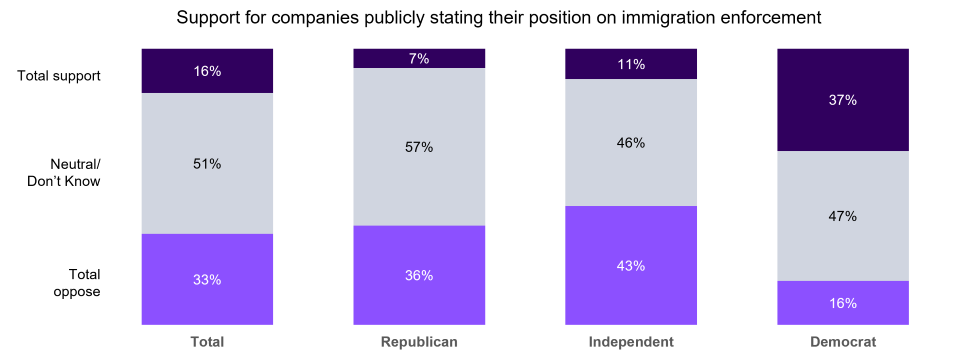
Just 16% of swing voters support companies publicly stating their position on immigration enforcement, while a majority feel neutral or have no opinion (51%). Democrats are somewhat more supportive than others (37% support).
The few who support companies taking public stances say it promotes transparency and helps consumers make informed choices. Some say it depends on the type of company and would be more acceptable if the issue directly affects them.
However, most feel that companies should stay focused on their core mission and avoid political involvement. There are also concerns that taking public stances risks alienating customers or would come across as performative.
Even those who say they are neutral on companies taking public stances are wary, preferring them to stay out of politics entirely. However, a few are plainly indifferent.
“I would find it informative to know their positions, so I can decide for myself whether to support them or not.” – Independent Swing Voter
“Unless it directly affects a company, I think all companies should stay out of politics.” – Republican Swing Voter
“Businesses should stay in their lane and concentrate on their business and not be political.” – Republican Swing Voter
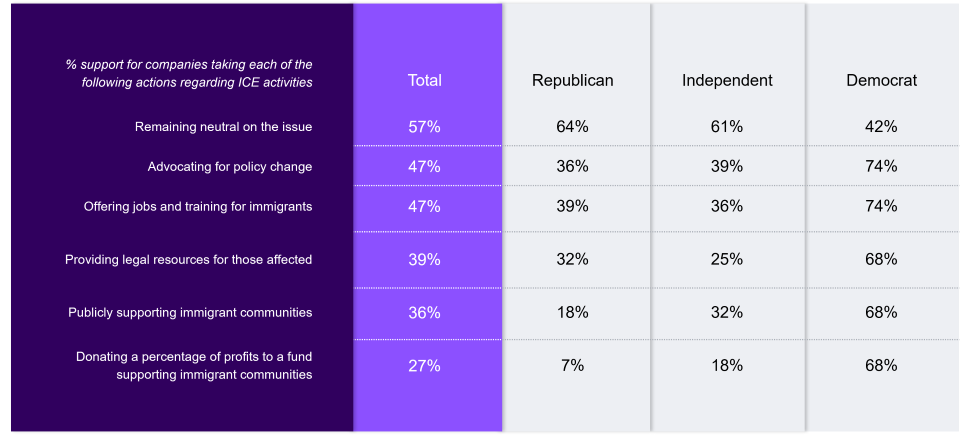
A majority of Republicans and Independents would prefer if companies remained neutral on ICE activities, while Democrats are more supportive of advocacy and action.
For more information, please reach out to insights@fgsglobal.com.
1 - TrendSpotters is FGS Global’s proprietary research tool. Our battleground community is composed of over 200 suburban swing voters (who have switched their vote or split their vote between parties in the last few major elections) in Pennsylvania, Georgia, Michigan, Wisconsin, Arizona, Nevada, North Carolina, Texas, and Maine. Data in this report should be considered directional in nature, as this research is inherently qualitative.