
Axios to Grind

A grid of vintage televisions showing colorful test patterns and static screens.

Axios to Grind

From podcasts to film sets to late-night television, the business of media is being rewritten in real time. Last week, Axios’ Media Trends Live Summit gathered decision makers and newsmakers from publishing, entertainment, sports, and media to discuss the state of the industry – from press freedom and speech rights to the importance of local news. FGS Global’s Media Entertainment Group (MEG) team was in attendance and have summarized their key takeaways:

  • Podcast economics under pressure. iHeartMedia CEO Bob Pittman suggested competitors are overpaying for podcast talent beyond what deals can realistically recoup.

  • Hollywood heads to Europe. Anonymous Content CEO Darren Walker announced plans to scale European film production, citing rebates and costs that make the region more attractive than the U.S. tax incentive environment.

  • SNL's ripple effect. Kenan Thompson weighed in on Shane Gillis' monologue, arguing one host's choices shape the whole show and that performers must understand how their material lands.

  • FCC's Disney standoff. Commissioner Anna Gomez predicted ABC will prevail in its First Amendment lawsuit against the agency, calling the license review retaliation for editorial decisions: "Capitulation breeds capitulation, but courage inspires courage."

  • Entertainment's race to the bottom. Writer-producer Lena Waithe dropped a ridiculous amount of soundbites that any comms pro would be proud of, including her take that "a lot of entertainment now feels like Walmart, feels like McDonald's."

  • WSJ holds the line. Dow Jones CEO Almar Latour and editor-in-chief Emma Tucker reaffirmed the Journal's editorial independence and signaled a push into video.

  • Truth Social goes global. TMTG CEO Kevin McGurn revealed active recruitment of creators to Truth Social, with ambitions beyond the U.S.: "I want more distribution, not just here in the U.S., around the world."

  • Live entertainment is winning. Revenue has nearly doubled since 2021 to $149 billion, with concert prices up 41.8% since 2016. In an environment where AI can replicate almost any digital experience, analysts see this as an AI-resistant growth story through at least 2030.

Learn how FGS Global’s media experts can help you navigate the intersection of business and entertainment on our website, or contact the Media Entertainment Group at meg@fgsglobal.com.

By the Numbers

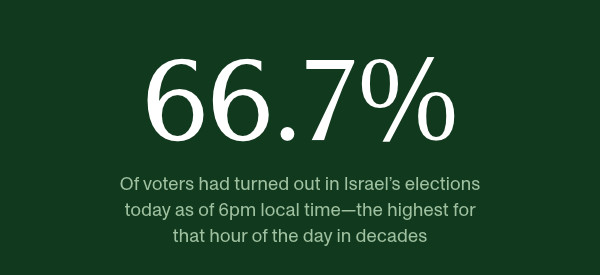
66.7% of voters had turned out in Israel's elections by 6pm, marking the highest for that hour in decades.

The Cybersecurity Treadmill

Abstract digital security concept with padlock icons overlaid on silhouettes of people and binary code.Last week, the Department of Homeland Security's Cybersecurity and Infrastructure Security Agency did something rare. The agency told organizations to disconnect systems from the internet if they could not immediately patch a flaw in PHP – software that runs roughly 70% of the world's websites – warning that hackers could remotely seize control of unpatched servers. 

No confirmed breach has surfaced yet, though hosting providers report large numbers of attempted attacks. Researchers using AI-assisted tools first identified the flaw – an early preview of the dynamic now reshaping cybersecurity more broadly. Widespread access to frontier AI models including ChatGPT, Claude, and Gemini has accelerated the battle between hackers and defenders. While attackers have gained a faster path to finding and exploiting vulnerabilities, software vendors are running the same playbook.

The numbers bear that out. Microsoft disclosed 964 new vulnerabilities in September alone. In October, that figure has surpassed 1,400. AI is driving vulnerability discovery to volumes the security industry has never managed at this pace, which means the window between disclosure and exploitation is narrowing.

It is not yet clear whether the PHP flaw becomes the next major cybersecurity crisis, or fades away as a near-miss. Either way, the underlying question remains open: has cybersecurity settled into a permanent standoff, where attacker AI and defender AI cancel each other out? Or does one side have an advantage that will enable them to build a real and lasting edge? For leaders, the practical answer is the window between vulnerability and exploitation is shrinking, and organizations still treating cybersecurity as an IT matter rather than a board-level priority will feel it.

Beyond the Beltway: Beijing's Export Playbook

A traditional Chinese archway, brightly lit at night, frames an ancient gate and buildings with intricate designs, against a deep blue sky.China is moving to deploy its own export control playbook in response to U.S. efforts to protect its AI innovation advantage. Beijing last week announced two tranches of export restrictions that reflect an increasingly deliberate approach to economic statecraft.

The Chinese government’s proposed AI controls draw particular attention: Beijing places its sharpest pressure not on American firms but on U.S.-aligned neighbors – India, Japan, and South Korea – whose AI infrastructure has grown dependent on Chinese models. That context makes Nvidia’s $12.93 billion acquisition of Hugging Face look well-timed, offering a potential Western alternative to Chinese AI models that are freely available for anyone to use and build on.

Decoding the controls

  • The more immediate risk falls on U.S. partners, not U.S. firms. Dependencies on Chinese AI technology create geopolitical and technical exposure for allied nations whose inference infrastructure relies on Chinese open-weight models. American companies should assess their partners' exposure, not just their own.

  • The Nvidia-Hugging Face deal is a geopolitical hedge as much as a business one. It puts the world of publicly available AI models squarely in American hands – at the exact moment China is asserting control over its own AI industry and the split between the two systems stops being theoretical and starts affecting real decisions. If your AI strategy relies on open, freely available models, now is the time to stress-test that assumption.

  • The compliance landscape is tightening from both directions. With the U.S. and China each expanding their export control regimes, technology companies operating across borders should review whether their partnerships remain adaptable in an increasingly active regulatory environment.

For tailored insights on sectoral, geographic, or scenario-specific risks, please reach out directly to geopolitics@fgsglobal.com.

October 27, 2026
By Nedra Pickler, Irene Moskowitz and Erin Barth-Dwyer

Share

Want to see more of this in your inbox?