What We're Watching in Food & Ag - Week of September 21

Driving the Week

President Donald Trump’s embrace of AI (or, depending on who you ask, SI – superintelligence) is emerging as one of the most politically treacherous issues of the midterm cycles, pitting the President’s Silicon Valley allies against his own rural base.

  • The President’s commitment to the industry was on full display at the state dinner for Chinese President Xi Jinping, where AI CEOs were seated at the head table, per The New York Times. 

  • Yet a recent New York Times/Siena University poll found that 61% of voters oppose data center construction, making it a rare bipartisan flashpoint. Though, less than 1% of likely voters listed AI/data centers as the single most important issue in deciding their vote this November.

For farmers and ranchers, the backlash is not abstract. According to an April 2026 American Farm Bureau Federation MarketIntel note, there were 4,925 active or under construction data centers across the U.S. – many of them racing into rural America specifically because agricultural land is flat, contiguous, and grid-connected. The same qualities that make it valuable for growing crops and raising livestock.

  • CNBC noted that land purchases for future data centers reached $6 billion in the first half of 2026, a 79% increase from the prior year. Though, data center construction isn’t the only reason farmland is declining in the U.S., as farm consolidation and land conversation has also played a role.

  • Aside from shrinking agricultural land, per The Wall Street Journal, farmers also fear being squeezed on energy.

  • According to the U.S. Department of Agriculture’s (USDA) Economic Research Service (ERS), agricultural electricity expenses are forecast to hit $8.5 billion in 2026, up 48% from 2019. 

The political fallout for Republicans is acute. The Financial Times reported that President Trump’s own pollster warned candidates in a leaked memo that "unqualified support for building more AI data centers is a losing position," cautioning against "treating local concerns as uninformed."

 The issue has not yet reached every likely midterm voter equally. A Galvanize Action poll shared by Out of State: The Politics & Policy of Rural America found that while fear of AI is widespread across moderate white women, most could not distinguish between the technology broadly and data centers specifically.

  • With 39 days until the midterm elections, voters and rural America will have a lot to compute before getting that “I Voted” sticker.

Post of the Week

DC Brief

The race to lead the House Agriculture Committee next year is officially underway on both sides of the aisle. For the Democrats, Rep. Shontel Brown (D-OH) formally launched her bid to replace Ranking Member Angie Craig (D-MN), who is leaving the House after a failed run for Senate, Agri-Pulse reported. She faces a challenge from the more senior Rep. Jim Costa (D-CA) in his third bid for House Ag leadership, according to Politico.

  • For the Republicans, drama is brewing over committee rules as Chairman Glenn "GT" Thompson (R-PA) is seeking a rare waiver to bypass the strict GOP six-year term limit and retain his top spot, per Progressive Farmer. He faces a direct challenge from Rep. Austin Scott (R-GA). 

President Trump’s FDA Commissioner nominee Dr. Heidi Overton faced the Senate HELP committee in her nomination hearing Thursday, fielding questions on food safety and FDA staffing. Pressed by Democratic senators on recent foodborne illness outbreaks—including cyclospora and infant formula botulism—Overton stumbled on basic agency specifics, failing to name the Human Foods division or identify its workforce size. Overton also signaled a willingness to override state-level additive bans, and Sen. Bernie Sanders (I-VT) took the opportunity to question Overton about childhood diabetes rates and junk food advertising, key tenets of the recent Senate HELP Committee-passed Childhood Diabetes Reduction Act.

Quick Bites

Outer-Rim Munchies. Grocery perimeters are shifting as produce brands realize consumers aren’t buying bigger yields – they are paying a premium to skip the prep. Add on a healthier snacking craze, and per Grocery Dive, we see major CPGs like PepsiCo making a push to the perimeter with fresh items like guacamole and hummus. 

  • Put down the peeler. Several potato giants are launching potato kit offerings built around quick-air-fryer and micro-steaming prep, complete with built-in sauce packets. Fresh Plaza highlights how CPG growers are repackaging raw potatoes into single-serve, bite-sized side-dish shortcuts to keep up with young home cooks. 

  • Beyond the spud: International Fresh Produce Association’s market data shows that pre-cut, single-portion, and “value-added” snack-sized produce continue to outpace traditional bulk commodities. As shoppers trade down on dining out but still look for micro-luxuries and time-savers, mini-cucs, snacking peppers and tomatoes, and single-serve dip packs are pulling in higher margins.

Food for Thought

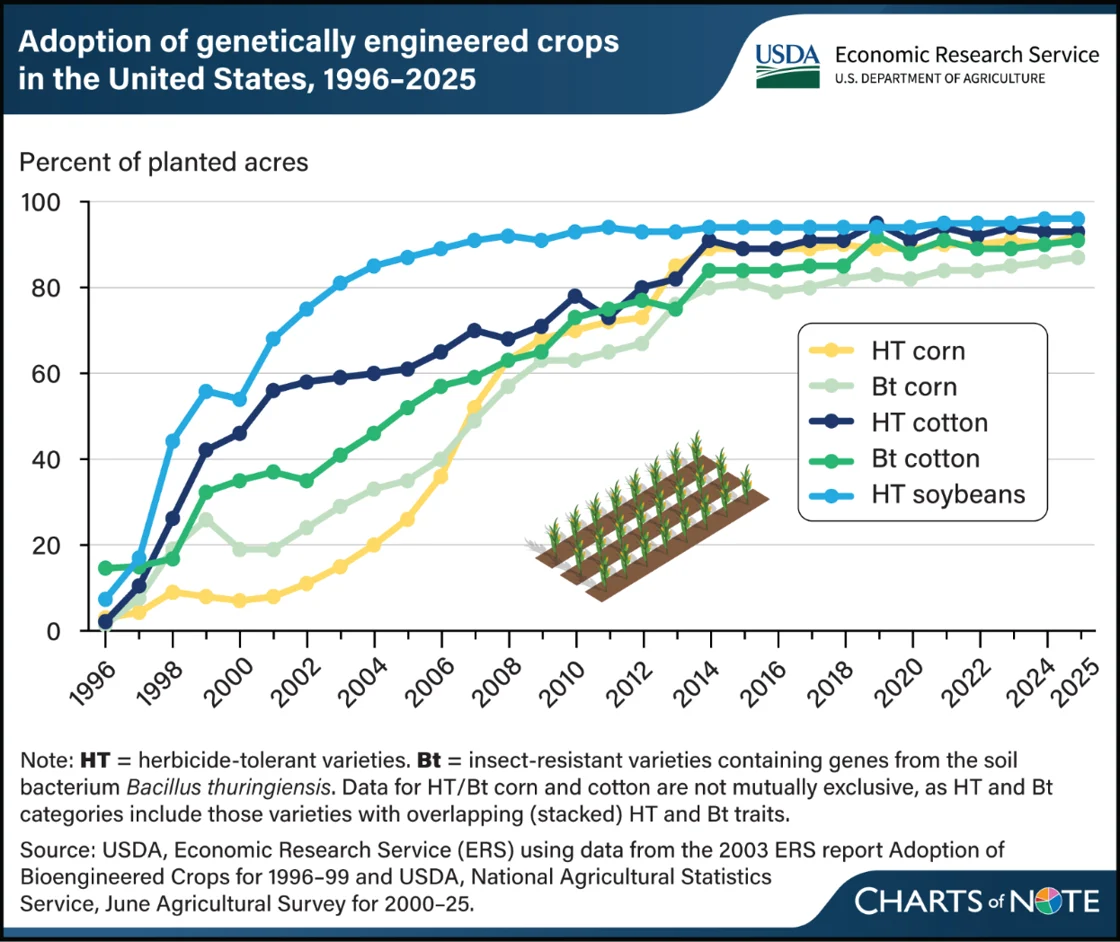
Since the introduction of genetically engineered (GE) seeds in 1996, U.S. farmers have increasingly adopted more GE seeds year-over-year, per USDA’s Economic Research Service.

  • Genetically engineered seeds went from commercial introduction in 1996 to covering more than 50% of corn, cotton, and soybean acres by 2008, and exceed 90% across all three crops today.

  • Herbicide-tolerant (HT) soybeans led adoption, reaching near-saturation in the early 2000s, well ahead of corn and cotton.

  • Cotton saw an increase in two trait types - herbicide-tolerant and insect-resistant – with adoption tracking closely together throughout the period.

  • Corn was the slowest to saturate, but accelerated sharply after 2010, driven largely by the rise of "stacked" seeds combining both traits.

September 21, 2026

Share

Want to see more of this in your inbox?