Board to Death?

Close-up of a conference table with a notebook and pencil, surrounded by empty chairs, in a bright meeting room.

Board to Death?

Global board directors are facing unprecedented challenges: geopolitical unpredictability, AI-driven disruption, rising nationalism and fragmented information environments. Drawing on FGS Global's Radar research, our Board Advisory team recently examined how boards can govern effectively in a fundamentally rewired world. They’ve outlined four critical capabilities:

  1. Expand your networks of eyes and ears. With 53% of directors receiving no real-time data between meetings, adaptive boards supplement internal analysis with stakeholder engagements, digital sensing tools and external advisors who distinguish signal from noise before competitors do.

  2. Practice "tight-loose coupling" with management. Effective boards create space for CEO vulnerability while maintaining rigorous accountability — structured autonomy that enables deep engagement without blurring who is in charge.

  3. Build robust decision architecture. Boards need protocols established in advance for cyber extortion, geopolitical ruptures or market shocks. A triage framework helps boards rapidly assess whether to act, react, adapt or monitor based on the nature and pace of change.

  4. Commit to learning – and unlearning. Boards must move from static governance to an always-on learning mindset, seeking outside-in challenges from broader stakeholder groups and digital natives.

For directors, the governance record is clear: boards with ineffective or slow decision frameworks create critical speed-to-remediation gaps. The question for 2026 isn't whether your board will be tested — it's whether you'll have built the muscle to respond before the test arrives. 
By the Numbers

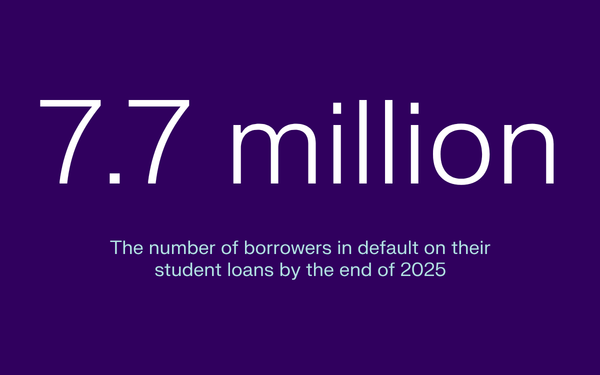
White text on a dark purple background reads: "7.7 million - The number of borrowers in default on their student loans by the end of 2025."

Read No Further

Stack of newspapers with "Fake News" headlines on a red background.A landmark survey by The Harris Poll is shedding light on the misinformation crisis gripping American science and health — and the findings are striking.

Here's what the data revealed:

  • The misinformation paradox is real: 80% blame social media for spreading science and health misinformation, yet continue using it as their primary source for this news.

  • We’re only reading the headlines: 75% of those who shared science and health articles did so based on the headline and without reading the article.

  • Young adults are tuning out experts: Half of 18-34 year-olds rely on social media for health and science information, and 1-in-5 distrust doctors and scientists.

  • It's taking an emotional toll: 83% feel angry when encountering misinformation, and 82% worry about their family's well-being.

  • Americans are anxious about the US falling behind: Only 19% believe the US leads China in scientific research, while 33% believe the US is falling behind China.

  • But there's hope: About 9-in-10 Republicans and Democrats agree rigorous science is necessary for human progress.

The bottom line? Despite the noise, divisions and worries, Americans across both parties still believe in science's value and in its importance for the country’s future.

Putting Beltway Media on NOTUS

NOTUS, the nonprofit newsroom led by Politico founder Robert Allbritton, is pursuing a significant rebrand and expansion. According to reports, the publication will be changing its name to The Washington Sun and appears poised to take on a bigger role in the D.C. media landscape. Our Health Media Insights colleagues have outlined what you need to know:

  • Staffing up. In an effort to double its roster of journalists from 50 to 100, NOTUS is bringing on veteran reporters with former ties to publications like The Washington Post, The Hill and Politico.

  • Broadening the beat. In addition to a continued focus on politics, with expanded reporting teams for federal agencies, campaigns and key issues, NOTUS also plans to add local news coverage and beef up its opinion section. Local reporting will cover news, sports and life in Washington, with an emphasis on the impact of D.C. power players. 

  • Leveraging the Politico playbook. The venture will continue to build on its roster of newsletters, podcasts and events, employing the model that Allbritton pioneered at Politico. A nod to Politico Pro and Bloomberg Government in the announcement could also signal the release of a similar professional subscription service in the future.

  • But keep in mind: While NOTUS is hiring veteran Washington Post reporters, its leadership has explicitly stated that they have no intention of replicating the Post. NOTUS won't publish a daily newspaper nor take on the reporting scale of a national outlet but instead stay streamlined and focused for a D.C. audience.

For more, subscribe to Health Media Insights by emailing the team at health@fgsglobal.com.

March 24, 2026
By Nedra Pickler, Irene Moskowitz and Erin Barth-Dwyer

Share

Want to see more of this in your inbox?