
Boardroom to Beijing

Exterior of the Hall of the People building in Beijing, featuring tall columns, red flags on the roof, and clear blue sky.

Beyond the Beltway: Boardroom to Beijing

When Presidents Trump and Xi Jinping sat down at the Great Hall of the People last week, the room extended beyond heads of state. Seventeen American executives joined the delegation, including those representing Apple, Boeing, Cargill, Citi, GE Aerospace, Illumina, Meta, Nvidia, Qualcomm, Tesla, and Visa. Premier Li Qiang hosted the same group separately, pledging that China would “stay committed to expanding high-standard opening up” and that U.S. companies should “plan and grow with confidence.”

Presidential trade delegations are not unusual, though this visit carried specific weight. One of President Trump’s stated objectives for the visit was to negotiate U.S. commercial access to Chinese markets. The delegation was assembled with that purpose in mind. The structure of the delegation sent a deliberate signal to the Chinese government and the world: that business cooperation between the two countries is a primary objective of U.S.-China engagement, not a byproduct of it. 

Pressure points:

  • Corporate access to government is now a competitive differentiator. In markets where policy and commerce are inseparable, positioning CEOs as diplomats is no longer a novelty – it is a strategic necessity.

  • It matters who is in the room. For U.S. companies without a presence in Beijing, it may be worth considering how that absence is perceived – both by Chinese authorities and regulators at home. 

  • The entourage economy has reputational stakes. When a company’s leadership sits at the diplomatic table, it becomes associated with the outcome – positive or negative. Exposure to these dynamics should be mapped as an integrated commercial, regulatory, and reputational risk.

Beyond the Beltway, a series from FGS Global's Geopolitics team, offering timely analysis on global geopolitical developments. For tailored insights on sectoral, geographic or scenario-specific risks, please reach out directly to geopolitics@fgsglobal.com.
By the numbers

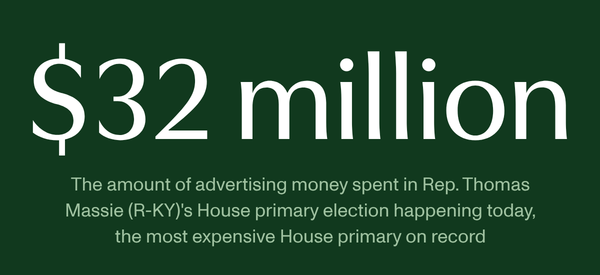
Large white text on a dark green background, reading: "$32 million." Underneath, smaller light-green text reads: "The amount of advertising money spent in Rep. Thomas Massie (R-KY)'s House primary election happening today, the most expensive House primary on record."

Drawing conclusions

Map of the USA filled with red, white, and blue "I Voted Today" stickers against a light blue background.Republicans have so far redrawn congressional maps in seven states ahead of the November 2026 midterms – a White House-backed push to blunt the structural losses the president's party typically absorbs in midterm elections. Democrats have countered where they hold power, producing one of the most aggressive mid-decade redistricting cycles in modern history. 

FGS Global’s Alternative Futures team have outlined the current state of play:

  • Republican wins: Texas, North Carolina, Missouri, Ohio, Alabama, Tennessee, and Florida have enacted favorable maps; Louisiana is expected to follow.

  • Democratic wins: California voters authorized new maps projected to net Democrats 3-5 seats.

  • Republican efforts blocked: Indiana's legislature rejected a White House-backed redistricting push.

  • Democrats’ efforts blocked: Virginia's Supreme Court invalidated a voter-approved initiative worth up to 4 seats; the U.S. Supreme Court blocked New York from redrawing maps that would have cost Republicans 4-5 seats.

The Supreme Court accelerated these efforts with its April 29 ruling in Louisiana v. Callais, which held that race-conscious redistricting violates equal protection even when aimed at preserving minority representation. The Court made the decision effective immediately, prompting Alabama, Mississippi, Tennessee, Florida, and South Carolina to pursue new maps in its wake.

Taken together, the redistricting cycle has narrowed – but not eliminated – Democrats' path to the majority. Current analyst estimates project a Republican net gain of 5-7 House seats from redistricting – meaningful in a 218-213 chamber, but likely insufficient on its own to overcome a political environment that still tilts toward Democrats retaking the House in November.

To learn more, reach out to the Alternative Futures team at us-midterms@fgsglobal.com. 

Conflict of interest

U.S. military action in Iran has introduced a volatile new factor that could significantly shape the midterm elections. With the majority of Americans currently opposed, and the conflict extending beyond the president’s original four- to five-week timeline, an ongoing military or economic conflict could negatively impact Republican prospects in November.

The public's verdict on the conflict is unambiguous. Just 28% of Americans support the war, while 60% oppose it – and sentiments on President Trump's handling of the situation runs equally deep, with 60% disapproving and only 31% in approving.

Meanwhile, the economic picture compounds the political problem. Since the conflict began:

  • Consumer sentiment has fallen to 48.9 on the Michigan index – a 7% drop from March, one of the lowest readings on record, and broad-based across every age, income and political group.

  • Inflation has climbed to 3.8%, reversing six months of declining prices; energy and housing account for roughly 40% of the increase.

  • Gas prices have risen to $4.51 per gallon nationally – up approximately 55% since the start of the conflict, with analysts warning further increases are likely.

Unlike most military engagements, the Iran conflict has produced no rally-around-the-flag dividend for the president. Instead, it has coincided with a measurable deterioration in economic conditions that cuts across demographic and partisan lines. If the war drags on and pump prices stay elevated into the fall, it may prove to be one of the most consequential variables in the November midterms.

To learn more, reach out to the Alternative Futures team at us-midterms@fgsglobal.com. 

May 19, 2026
By Nedra Pickler, Irene Moskowitz and Erin Barth-Dwyer

Share

Want to see more of this in your inbox?