NATO Much To Ask?

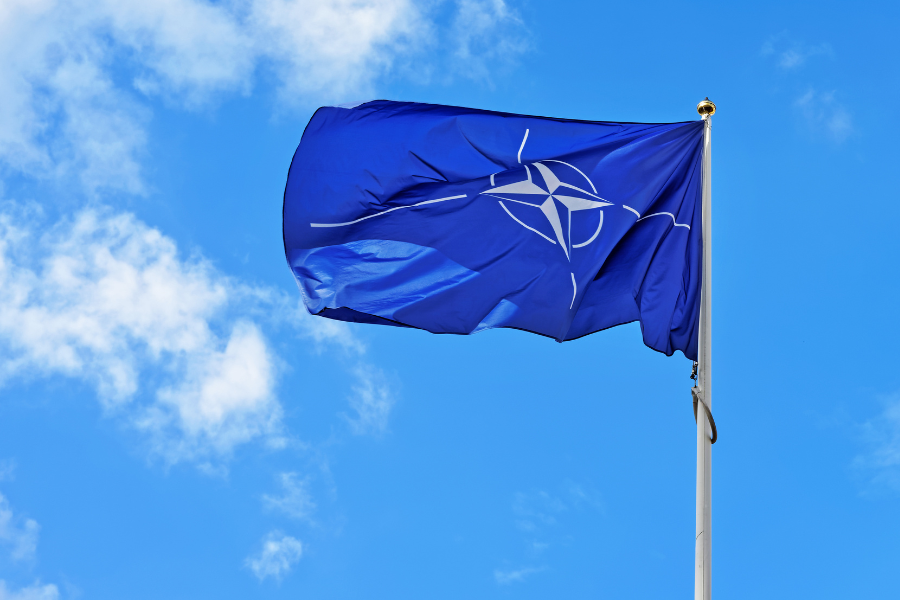
NATO flag waving against a blue sky with scattered clouds.

Beyond the Beltway: NATO Much To Ask?

Heads of state recently convened in Ankara for the annual NATO Summit against an increasingly challenging geopolitical backdrop: allied reluctance to join the U.S. war in Iran, persistent scrutiny of defense contributions, and Russia's enduring threat. The two-day Summit focused on turning pledges into tangible outcomes, reaffirming alliance cohesion, and sustaining collective aid for Ukraine. Secretary General Mark Rutte said the alliance’s focus has “shifted decisively from setting targets to delivering results.”

The numbers made the case. Allies announced more than $50 billion in new procurement commitments spanning precision strike, air and missile defense, and pledged at least $80 billion in military support for Ukraine in 2026, with equivalent levels committed for 2027. The Summit declaration reaffirmed allies’ “ironclad commitment” to collective defense under Article 5. President Donald Trump, who opened the Summit by reiterating his longstanding critiques of allied contributions, closed it crediting the alliance with “making great progress.”

Allied Interests:

  • Market access is changing shape. The Summit codified Rutte’s ‘NATO 3.0’ agenda: a stronger Europe assuming greater responsibility within the alliance, with commitments to expand collective manufacturing and eliminate defense trade barriers among allies. For U.S. and non-European firms, localization and alliance-country footprint will increasingly determine who competes.

  • Defense spending is undergoing a structural shift, not a cyclical one. Companies exposed to precision munitions, air defense, and unmanned systems should plan accordingly. 

  • Ukraine is becoming a defense-industrial partner. Trump pledged to license Patriot interceptor production in Ukraine, which would make it only the third country with that capability. While any output would be years away, companies should track Ukraine’s entry into allied supply chains. 

For tailored insights on sectoral, geographic, or scenario-specific risks, please reach out directly to geopolitics@fgsglobal.com.


By the Numbers

Light text on a dark green background reading: "507 pounds: the weight of one of the flags unveiled on the field before each World Cup match."

When Duty Calls

A large cargo ship loaded with colorful shipping containers docked at a busy port, surrounded by cranes and workers under a partly cloudy sky.As Trump’s tariff regime is gaining a more durable legal footing, companies should move just as deliberately. After the Supreme Court struck down the administration's IEEPA tariff authority, the White House has leaned on a temporary measure while building a longer-lasting legal foundation for its trade agenda. That more durable framework is now taking shape, with new tariffs expected to closely mirror current levels once the shift is complete this summer.

For companies, a firmer legal basis does not mean a calmer environment, and waiting out the transition is a mistake. Several open questions remain: How will these new tariffs interact with other duties already in place? Could a second, broader wave follow, straining trade arrangements like the one recently reached with Europe? 

Companies should also drop the assumption that a future administration reverses course wholesale – tariffs introduced in Trump's first term persisted under Biden, and 2028 planning should reflect that continuity rather than a return to pre-2025 norms. Three priorities should anchor near-term planning:

  • Assess exposure from ongoing trade actions and build a prioritized, evidence-based advocacy strategy rather than a reactive one.

  • Map supply chain vulnerabilities against shifting trade routes and sourcing, recognizing that exposure varies sharply by sector.

  • Track implementation, not just headlines — how existing deals are actually playing out, alongside the broader geopolitical currents shaping them.

One point is often overlooked: these tariffs are paid by U.S. importers, not foreign exporters. That makes honest dialogue with American customers about cost pass-through a real strategic asset. Companies that have already had these conversations will be far better positioned than those scrambling once the next round lands.

To learn more, read about The Road Ahead for U.S. Tariffs on our website.

Video Killed the Press Release Star

Laptop screen showing a paused video with a large play button. Hands in the background hold a pen and smartphone.Reporters at the country's biggest outlets are increasingly arriving to stories with video in mind from the start. Social media and video networks are now the single most widely used way people access online news globally, ahead of publishers' own websites and apps for the first time, according to the Reuters Institute's 2026 Digital News Report cited by our colleagues on the FGS health team. Nearly 80% of news publishers say investing in video is a top priority in response. 

Understanding how key outlets on your organization's media lists approach video will help you anticipate what reporters need and show up as a prepared, attractive source. Here's how three outlets are building that out in practice:

  • The New York Times hired eight new journalists for its video department in January, with some focused on collaborating with reporters to expand their stories and some working across both reporting and video production. The Times has grown its video footprint, producing short-form explainers and news clips on Instagram and TikTok and longer documentary-style videos tied to investigations.

  • Axios has institutionalized video through The Axios Show, a long-form series featuring journalist-led interviews with newsmakers across politics, technology, and culture. Between full episodes and clipped excerpts distributed on YouTube, X, Instagram, and TikTok, the show has reached more than 100 million viewers, and its YouTube subscriber base grew 17% over the first season. 

  • The Wall Street Journal runs a dual-track video operation: WSJ News produces short-form clips for YouTube, Instagram, and TikTok keyed to breaking business and political stories, while longer video content provides deeper market and earnings analysis for subscribers.

July 14, 2026
By Nedra Pickler, Irene Moskowitz and Erin Barth-Dwyer

Share

Want to see more of this in your inbox?