How Meta and Bluesky are shifting control back to users with AI
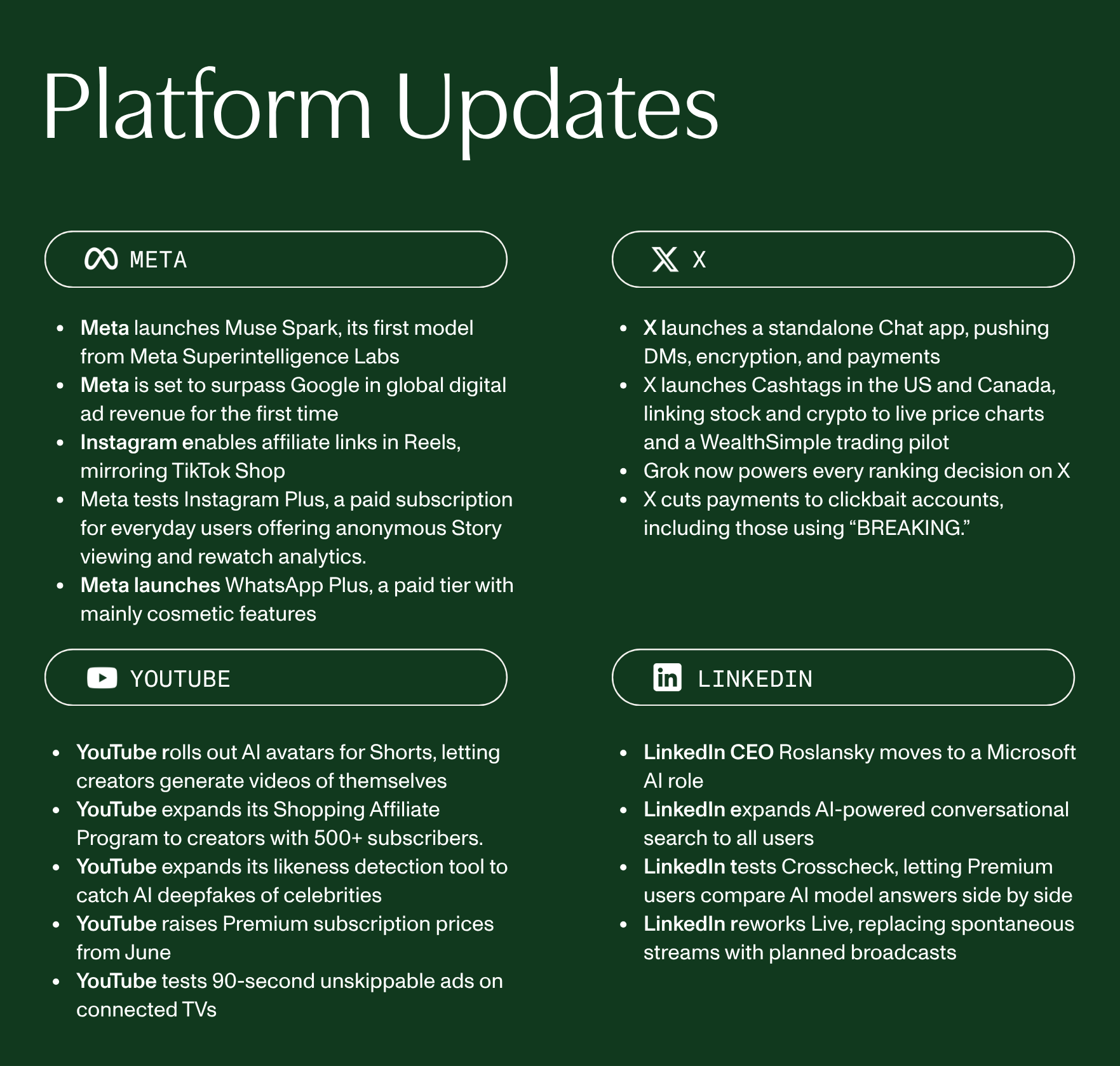
State of play: The competition to put AI at the center of user experience is intensifying. Meta has unveiled ‘Muse Spark’ its first major AI model since acquiring Alexandr Wang’s company, aiming to integrate advanced, user-facing AI tools across its platforms. Meanwhile, Bluesky is rolling out Attie, an app that lets users build custom social feeds with natural language prompts, shifting feed curation from opaque algorithms to direct user control.
Why it matters: AI is moving from a backend tool to a front-facing feature, empowering users to personalize content and shape their algorithms and digital environments. This shift promises more transparency and customization, but also challenges platforms to balance user agency with responsible oversight. The next phase of digital engagement will be defined by how well platforms deliver both control and trust as AI becomes central to daily online life.
Threads pushes for relevance in Japan’s social scene
State of play: Meta is making a high-stakes bet on Threads in Japan, a market defined by its lively, text-based social culture and strong loyalty to X. To gain traction, Meta has rolled out localized features, a Japan-specific Threads profile, and prioritized early ad testing, shifting from a global playbook to a market-specific strategy. While Western platforms have often struggled to break through in Japan, LinkedIn recently surpassed 5 million users nationwide, showing that with patience and adaptation, international platforms can find a foothold.
Why it matters: Japan is a proving ground for Threads’ ambitions, cracking this market could signal its potential to shift user behavior in other territories. For brands and creators, Threads’ expansion opens new ways to reach Japanese audiences, but success will depend on local relevance and community engagement. LinkedIn’s steady growth also provides a subtle reminder: even in challenging markets, global platforms can win trust and scale with the right approach though acknowledging there’s still some way to go.
TikTok’s expanding empire into finances and data
State of play: TikTok is seeking approval from Brazil’s central bank to launch digital wallets and credit services within its app, aiming to operate as both an electronic money issuer and a direct credit company. If granted, these licenses would allow TikTok to offer in-app payments and lending to its massive Brazilian user base, embedding financial services directly into the platform. At the same time, TikTok is investing $1.2 billion in a second data center in Finland, strengthening its European infrastructure and signaling its ambitions to become a key player in both digital finance and data sovereignty on a global scale.
Why it matters: TikTok’s entry into Brazilian fintech and its investment in European data centers mark an aggressive bid to control both user finances and data. As TikTok embeds itself deeper into core digital infrastructure, its influence over how people pay, share, and store information is set to grow, raising urgent questions about oversight, competition, and user autonomy.
Anthropic’s Claude Mythos is too dangerous for public release
State of play: Anthropic has unveiled Claude Mythos, an AI model capable of autonomously finding and exploiting security flaws in major operating systems and browsers. Due to its potential for misuse, Mythos isn’t publicly available; it’s being shared only with select tech companies and infrastructure providers to help strengthen defenses. Early tests have exposed thousands of new vulnerabilities, prompting industry and government warnings about the risks of such powerful AI tools.
Why it matters: Mythos signals a turning chapter for cybersecurity, where advanced AI can both protect and threaten digital infrastructure. Restricting its release highlights growing concerns about AI safety and the urgent need for new oversight frameworks.
Europe wants to break up with Big Tech. It can't.
State of play: EU governments are accelerating efforts to reduce dependence on U.S. technology platforms, driven by concern that Washington could effectively cut off European digital infrastructure. Amsterdam is leading one of the most concrete attempts, with a plan to migrate sensitive city data to European clouds by 2035. The urgency sharpened after the International Criminal Court's chief prosecutor lost access to his Microsoft account following U.S. sanctions. A new EU digital sovereignty legislative package is due May 27.
Why it matters: The dependency is structural and won't unwind quickly. For companies operating across the EU, this creates a new layer of risk: as governments push toward European alternatives, procurement decisions, data residency requirements, and platform choices are all likely to become more politically charged. The question is no longer whether Europe will act, but how disruptive the transition will be.
Shrinking newsrooms and growing creator networks
State of play: After newsroom layoffs, The Washington Post is pivoting to creator-led video content as a new revenue strategy. The Post has launched its first creator-driven video series and is building a network of external creators, offering a unique IP-sharing model that lets creators retain ownership of their content. This approach aims to cut costs and attract top creative talent while reaching younger, digital-first audiences.
Why it matters: The Post’s shift highlights a broader media trend: as legacy newsrooms shrink, outlets are turning to creator partnerships to fill content gaps and drive engagement. By letting creators keep IP rights, The Post hopes to stand out in a competitive market for talent. While this may help diversify revenue and reach new audiences, it also raises questions about editorial standards, brand identity, and the long-term effects on news quality and credibility.