The big business of burning

The Macro - The big business of burning

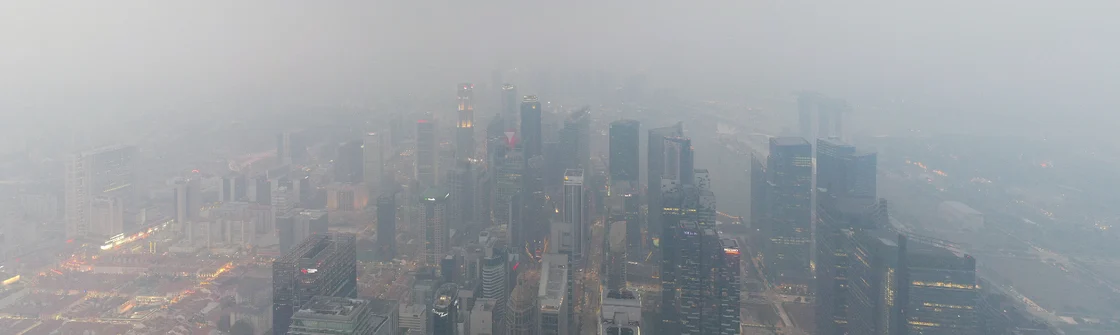
Insight: With Southeast Asia’s dry season now in full swing, the region is choking on an all-too-familiar problem as Indonesia’s worst spate of wildfires in more than a decade has led to haze spreading to Singapore, Malaysia, and even Vietnam and the Philippines. Behind the smoke is the multi-billion-dollar palm oil industry, which has long been associated with deforestation and land clearing through burning. Interestingly, however, this year’s crisis is playing out in courtrooms and boardrooms: Indonesian authorities are now investigating over 200 people and dozens of companies and revoking permits, while civil society groups in West Kalimantan have filed a class-action lawsuit against the Indonesian government for alleged negligence. Similarly, in Malaysia, environmental groups have taken to the streets and Parliament to demand stronger laws to hold companies accountable for environmental damage abroad.

Impact:  Much like the haze itself, the cross-border supply chains underpinning Southeast Asia’s economic integration that generate investment, employment and export revenues are worryingly opaque. And the mechanisms for holding companies accountable have struggled to keep pace: 70% of fire spots in Indonesia were found within palm oil plantation concessions held by companies linked to Singaporean and Malaysian business groups. Some of these firms are SGX-listed and subject to mandatory sustainability reporting requirements, yet no company has been prosecuted under Singapore’s Transboundary Haze Pollution Act since its introduction in 2014. And as climate change increases the risk of more frequent and severe wildfires, companies and governments alike are feeling the heat. The question is whether mounting public pressure can finally translate into meaningful accountability, or whether the region will be left fighting the same fires year after year. 

Asia by numbers – 1/5

China’s urban unemployment rate among 16- to 24-year-olds, excluding students, stood at roughly 19% in August – meaning nearly one in five young people do not have a job. A generation raised to believe hard work guaranteed a better life now faces scarce good jobs, fierce competition, and AI threatening entry-level roles. The consequences go beyond lost income, as young people lose faith that they will ever be financially secure enough to marry or start a family.

The Micro – Japan's cyber wake-up call

Insight:  In recent weeks, more than 20 major Japanese companies have been subjected to substantial cyberattacks. In an emergency meeting, the government's National Cybersecurity Headquarters declared a "state of emergency in cyberspace." Times Car, a car rental company, disclosed that more than 6 million customer accounts had been hacked, with stolen driver's license photos selling for as little as ¥25 ($0.15) a piece on the dark web. Japan is not known for its digital adoption, and in 2021 the International Institute for Strategic Studies placed it in the lowest of three tiers in an assessment of national cyber capabilities. As recently as 2018, Japan's then cybersecurity minister made headlines after admitting he had never used a computer.

Impact:  The recent spate of attacks has heightened the sense of urgency in strengthening Japan's cyber defenses. In response to the Times Car breach, the Financial Services Agency has urged lenders to quicken their shift to only accepting forms of identification that contain IC chips. Japan's pacifism also complicates matters, and as part of a broader security overhaul, a new law will allow the Self-Defense Forces and the police to pre-emptively infiltrate and neutralize hostile servers. However, questions remain as to whether Japan's renewed efforts will be enough. Experts believe that Japan is especially vulnerable to hackers because its aging population has led to poor security practices, a trend unlikely to reverse. More troublingly, with Japan already behind in terms of capabilities, there is growing concern about whether it can defend against a new generation of AI-enhanced cyber threats.

News you can use - India’s free payments era gets a price tag

Insight: India spent years teaching more than half a billion people that moving money should cost nothing. It worked almost too well. The Unified Payments Interface (UPI) now handles roughly 25 billion transactions a month, and 84% of the country’s digital payments, but keeping the infrastructure free has left banks and payment companies carrying much of the bill. India was due to introduce a 0.4% fee on larger merchant payments this week, before deciding that the eve of Diwali was perhaps not the moment to start charging retailers for the country’s favorite way to pay. 

Impact: The delay only postpones the bigger question: how do you monetize digital infrastructure once consumers have come to regard “free” as a feature, not a subsidy? UPI’s zero-cost model was central to its adoption, but sustaining a network of this scale requires someone to pay for fraud prevention, technology, and expansion. India has already solved the difficult part of getting people to use digital payments; convincing businesses that they should now help fund them may prove trickier.

If you read one thing this week - Japan gears up for a more commercial space race

Japan already spends heavily on space. Its budget, the world’s third largest after the U.S. and China, has primarily financed scientific missions, including sending probes to the Moon, Mercury, Venus and the asteroid belt, with plans to also explore Mars. Now the government is switching focus to commercial satellite networks, using the country’s skills in building and launching rockets to full advantage. The first step is to add new launchpads and increase rocket liftoffs to 30 per year. While the target is laudable, it reveals how far behind Japan has slipped: the U.S launched almost 200 rockets last year.

October 16, 2026

Share

Want to see more of this in your inbox?