
Reput-AI-tion Management

A human hand and a robotic hand reaching towards each other with fingers almost touching against a light gray background.

Reput-AI-tion Management

AI is simultaneously the most used and least trusted technology in widespread circulation today. Adoption is surging, policymakers are growing anxious, and the window to shape public opinion is open but narrowing. For leaders with AI at the center of their strategy, the central communications challenge is no longer awareness, it’s trust. 

FGS Global's new Radar AI Pulse report draws on insights from 39 senior leaders and polling of over 7,000 people to identify where opinion stands and what moves it:

  • Usage is widespread – trust is not. 71% of respondents have used an AI tool in the past six months. Yet AI scores a net trust rating of just +18% – well behind social media (+35%), and streaming and entertainment platforms (+65%), online banking (+69%), smartphones (+74%), and search engines (+78%).

  • The public is persuadable. When presented with AI's concrete benefits, 37% of respondents become more positive. The benefits that land hardest are practical and visible – everyday convenience, access to expert knowledge, solving complex problems, and scientific breakthroughs.

  • Expert opinion is converging with public skepticism. Senior policy leaders who were broadly optimistic about AI six months ago now report heightened concern, citing cybersecurity incidents and geopolitical developments as turning points.

  • Safety concerns are at the forefront. 63% of the public believe AI safety should be prioritized over the global race for AI leadership. Only 7% think companies should self-regulate on cybersecurity.

To learn more, download the report or sign up for future FGS Global Radar reports, visit the FGS Global Radar webpage.

By the Numbers

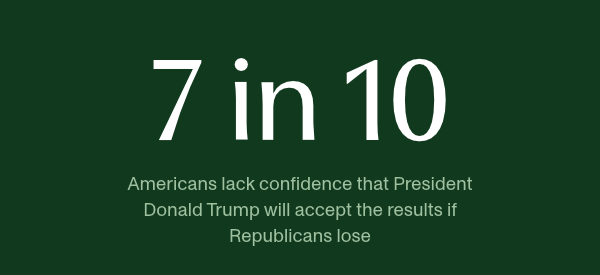
"7 in 10 Americans lack confidence that President Trump will accept election results if Republicans lose."

Disclosure Discipline

A human hand and a robotic hand reaching towards each other with fingers almost touching against a light gray background.The SEC isn't coming for you right now – but whoever runs it after January 2029 might be. That was a recurring theme at last week's Incident Response Forum West in Beverly Hills, where several hundred attorneys, incident responders and other cyber professionals gathered to trade notes on the state of cyber disclosure enforcement. FGS Global co-sponsored the event, and Jim Finkle, a senior leader of the FGS cybersecurity practice who spoke at IRF, outlined what companies get wrong when the clock is ticking.

The experience of software maker SolarWinds shows how that can play out. Russian state hackers infiltrated the company during President Trump's first term. Nearly three years after the attack, the Biden SEC sued SolarWinds and its chief information security officer, alleging they'd misled investors. A judge threw out most of the claims in 2024, and the SEC under the second Trump administration dismissed the rest.

Advance preparation for a cyber incident can help avoid missteps that lead to regulatory scrutiny. Teams should work with attorneys to draft all communications expecting them to become public, even private correspondence with employees and customers. In a recent FGS Insights blog, Finkle notes that downplaying the impact of an attack before the details are known can create credibility problems if the incident drags on. Public disclosures need similar discipline, and future regulators should be considered part of the audience.

Fission Impossible?

Nuclear power plant with cooling towers emitting steam, set against a blue sky and surrounded by a field of red poppies.The U.S. is facing an energy demand shock unlike any in a generation. AI data centers, electrification of transportation and industry, and retiring baseload capacity are converging to create grid pressure that intermittent renewables cannot absorb alone. Nuclear is the only mature, firm, carbon-free technology that fits that description at scale. FGS Global's energy experts recently outlined why the regulatory environment is now the make-or-break variable for companies and investors betting on advanced nuclear's role in solving that problem.

What leaders need to know:

  • Public support is conditional. A 2026 study found 77% of Americans favor nuclear energy, but 72% insist regulations remain strict even if it slows new projects. Developers who are seen cutting corners will lose the public before they break ground.

  • The perception of evasion is the real threat. The lesson of Three Mile Island and Fukushima is not that safety killed nuclear – it is that the perception of cutting corners did. Developers who undercut visible oversight will lose the public before they break ground.

  • The regulatory framework is improving but incomplete. The NRC's new Part 53 licensing rule is the first new reactor framework in decades. Two gaps remain: it lacks a codified safety threshold, leaving developers to default to legacy benchmarks, and it provides no formal transition pathway from older licensing frameworks.

Companies navigating the advanced nuclear regulatory environment should reach out to FGS's Energy, Climate Tech & Natural Resources experts.

October 20, 2026
By Nedra Pickler, Irene Moskowitz and Erin Barth-Dwyer

Share

Want to see more of this in your inbox?