
The United States is experiencing an energy demand shock unlike any in a generation. The rapid buildout of AI data centers, broad electrification of transportation and industry, and the retirement of aging baseload capacity are converging to create grid pressure that intermittent renewables cannot absorb alone. What the moment requires is firm, carbon-free power that is available around the clock, regardless of weather. Nuclear energy is the only mature technology that fits that description at scale. The question facing the country is whether it can be built fast without cutting the safety standards that make it trustworthy in the first place.
Nuclear energy is a rare issue that receives bipartisan support. Democratic governors are moving to encourage new, advanced nuclear development alongside an administration that has made energy dominance a pillar of national strategy. In 2025, 45 states were engaged in nuclear policymaking, with over 350 related bills introduced in state legislatures. Nuclear energy is more than just a climate policy debate, it’s an issue concerning national security and economic competitiveness.
Yet as urgency builds, some argue that regulatory oversight is the obstacle standing between the U.S. and its advanced nuclear future, and that rapid deployment means safety considerations go to the wayside. But strict safety standards aren't slowing nuclear down — they're what makes it possible. The public wants both speed and rigor, and advanced technology can deliver both.
A Closer Look at Advanced Reactors
Advanced nuclear is a category of new nuclear designs that are often more compact than the conventional nuclear we know, in addition to being safer and more efficient than traditional nuclear power plants. Small modular reactors (SMRs) are factory-fabricated reactors designed to be deployed incrementally and at sites previously unsuitable for large-scale nuclear designs. Some SMR designs boast factory-fabricated and easy-to-transport features. Microreactors are an even leaner class of advanced nuclear technology with similar characteristics to SMRs, with developers flaunting its suitability for remote communities and industrial facilities that require reliable, off-grid power.
Both reactor types are built around passive safety systems, meaning no human intervention or external power is required in the event of an emergency, thanks to the physical and thermodynamic properties of advanced nuclear designs. With the correct frameworks in place, advanced nuclear designs can support faster, more efficient regulatory reviews precisely because their safety case is structurally simpler.
Integral to successfully scaling the deployment of advanced nuclear, whether small modular reactors or microreactors, is ensuring reliability, trust, and safety standards.
What the Public Actually Wants – and Why Cutting Corners Fails
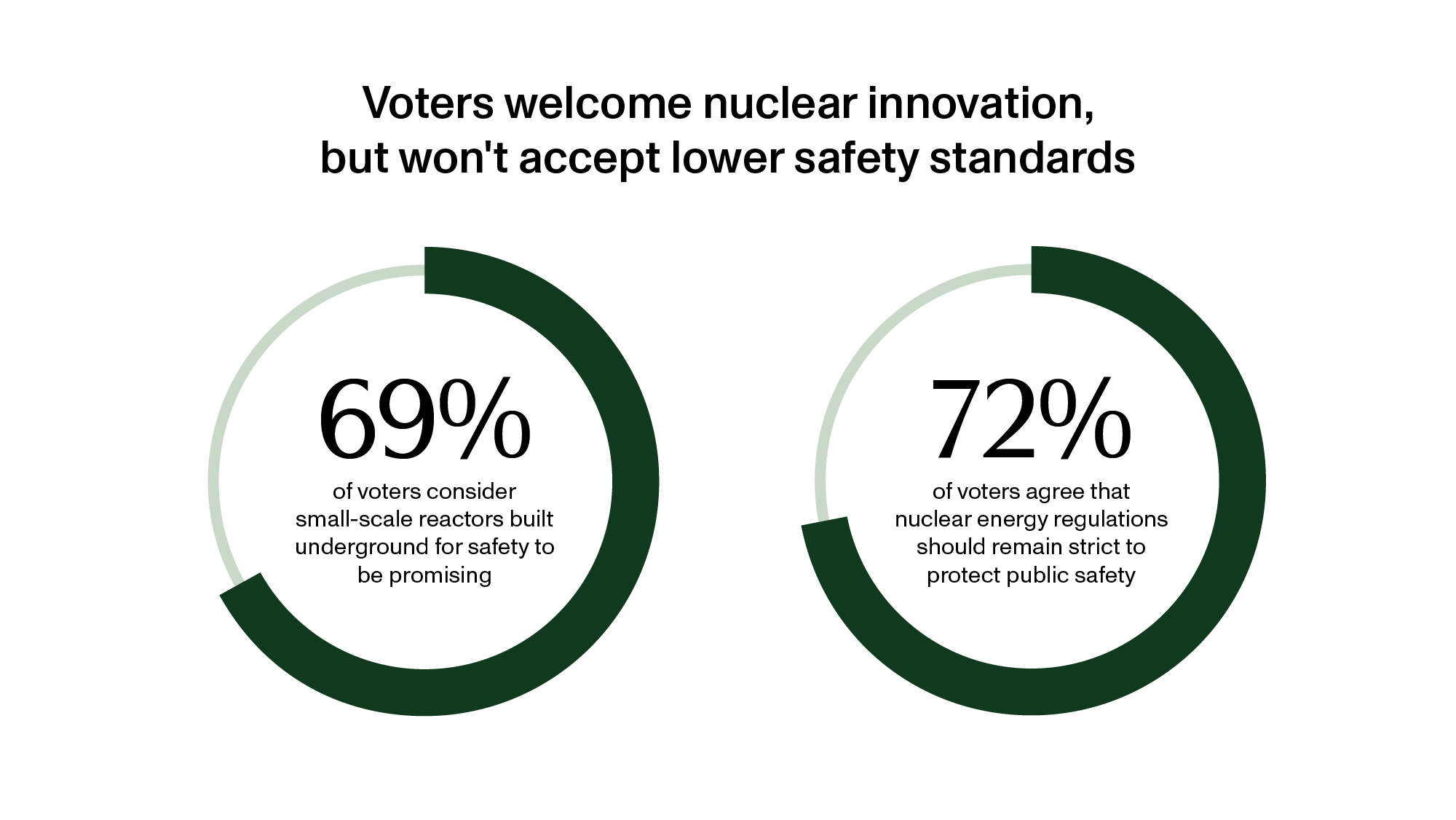
A 2026 study found that 77% of the U.S. public favors nuclear energy as a way to provide electricity in the U.S., and that 70% would find it acceptable to add an SMR next to an existing nuclear plant nearest to where they live. New research conducted by FGS Global’s in-house insights team similarly reveals that more than two-thirds of voters find small-scale reactors that can be built underground for safety to be promising.[1]
But that support is not unconditional – it is tied to the credibility of current oversight institutions and trust in the technology itself. FGS’s research shows that 72% of voters agree that nuclear energy regulations should remain strict to protect public safety, even if it slows down new projects. In short, safety is a non-negotiable expectation of the public.
The public wants faster deployment with robust standards, not faster deployment instead of them.
The historical nuclear record reinforces this. Oversight in safety communication produced the public trust (or lack thereof) environment that stalled the sector following Three Mile Island and Fukushima. What stalled nuclear development and deployment after these events was not safety itself, but the perceived evasion of it.
Perceived evasion of safety kills projects politically. Weakening nuclear regulations and the U.S. Nuclear Regulatory Commission’s (NRC) perceived independence or authority erodes the very credibility that allows nuclear to continue operating today. For example, the recent proposal from the U.S. Department of Energy (DOE) to categorically exclude advanced reactors from evaluation under the National Environmental Policy Act (NEPA) – a law fundamental to protecting environmental health and safety – is being viewed as an overcorrection. But it’s not a blanket exclusion: the DOE grants it only when a project’s fission product inventory, fuel type, reactor design, and operational plans sufficiently reduce the risk of off-site consequences, and only where hazardous waste can be properly managed. Senator Sheldon Whitehous (D-RI), Ranking Member of the Senate Environment and Public Works Committee, has raised a sharper objection: that the DOE’s safety criteria are circular, assuming a reactor achieves the safety characteristics of an “advanced reactor” simply because it is designed to be one, rather than requiring that safety be demonstrated.
To overcome these concerns, our research shows that voters find two safety signals most important: advanced safety technology in plant design (45%) and independent safety reviews by experts unaffiliated with the nuclear industry (40%), when selecting their top three. Crucially, there is no partisan divide – Republicans and Democrats are largely consistent in how they prioritize safety signals.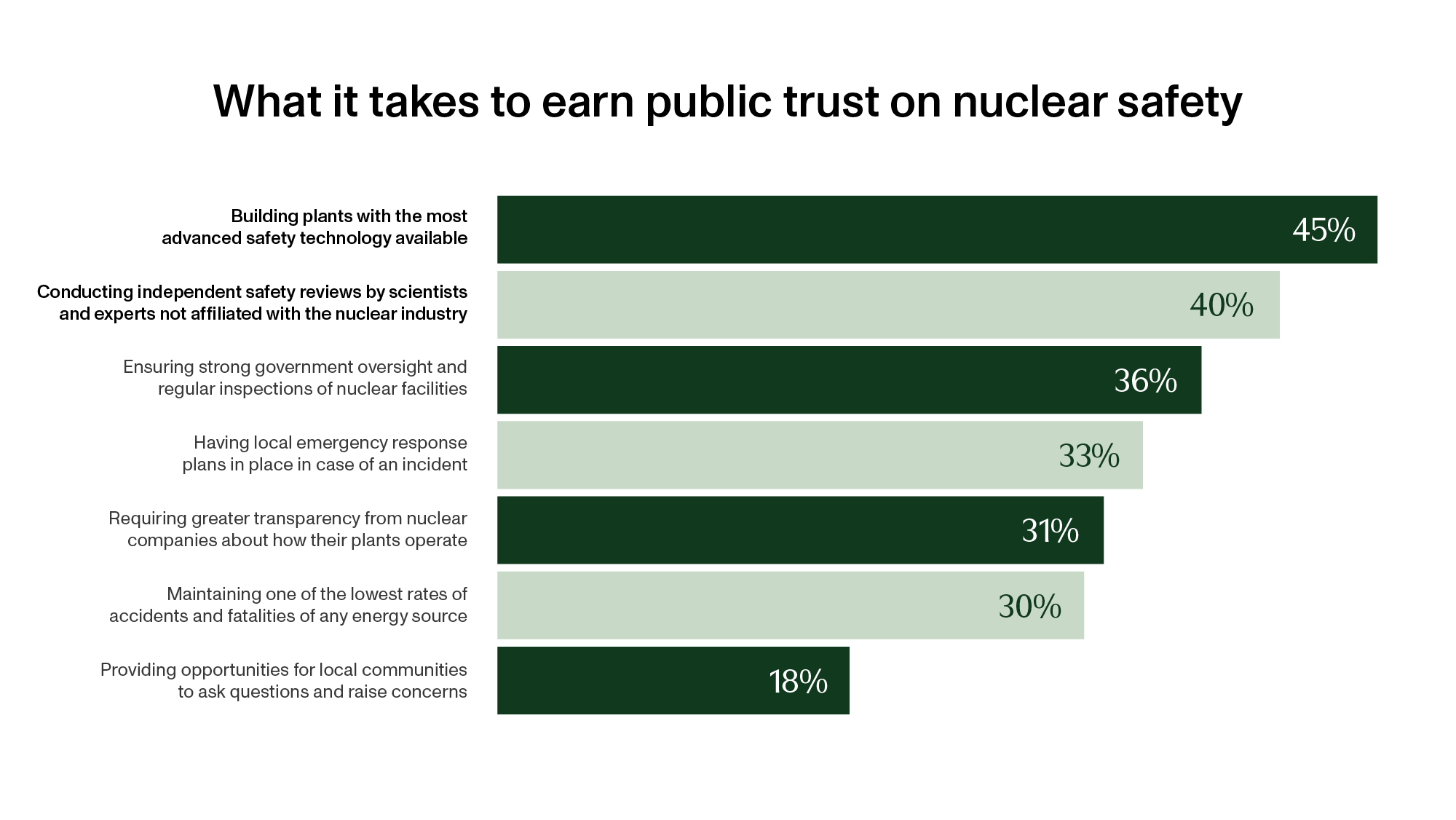 The State of Advanced Nuclear Regulation Today
The good news is that the regulatory framework is veering in the right direction. The Nuclear Energy Innovation and Modernization Act (NEIMA), enacted in 2019, directed the NRC to develop a technology-inclusive, risk-informed, and performance-based licensing framework for advanced reactors. That mandate produced Part 53, the first new reactor licensing rule in decades. The core purpose of Part 53 is to have novel technologies assessed based on their actual risk profile rather than forced into a regulatory mold designed for an older generation of plants.
Part 53 is a genuine milestone, but gaps remain before it can be written as a success. First, the framework does not define a clear standard for what constitutes acceptable safety performance. It allows applicants to propose their own risk metrics, but without a codified threshold, most developers will default to previously established benchmarks of previous generations to avoid regulatory uncertainty. This creates an implicit standard where an explicit one would better serve both the industry and public. Second, the NRC has not codified a formal pathway for transitioning from Parts 50 and 52 into Part 53 and has explicitly stated that Part 53 applicants cannot directly reference approvals issued under those frameworks. This is more restrictive than simply declining to define a transfer process: it prevents applicants from leveraging prior licensing decisions, even where the underlying safety case is substantially comparable.
Conclusion & Recommendations
Modernized safety frameworks and advanced nuclear technologies cannot be competing forces; the regulatory reforms now underway can achieve both maintained safety and increased regulatory efficiency for advanced nuclear technologies if the proper structures are in place.
Flexibility without clarity produces uncertainty, and uncertainty creates delays. Demystifying components of Part 53 and finalizing companion documents on codes, standards, and inspection requirements, in addition to structured guidance for applicants transitioning from older review models (i.e. Parts 50 and 52), will help usher in a new era for advanced nuclear deployment in the U.S. On the agency side, thousands of hours are put into a single NRC application; investing in NRC institutional capacity will also aid in streamlining the application review process without reducing the rigor of the process itself.
Firm, carbon-free energy capacity cannot be viewed as a long-term planning aspiration against the backdrop of surging global electricity demand and geopolitical competition over energy supply chains. Advanced nuclear reactors are emerging as one of the only solutions capable of delivering both baseload and zero-carbon energy at scale and open doors to deployment beyond the limitations of conventional reactors. The companies and regulatory agencies that prove rigorous and rapid deployment along with robust safety standards are achievable will define the nuclear renaissance for the next decade-plus.
[1] Results are based on an online survey conducted from April 22-27, 2026, among 1,000 U.S. registered voters nationwide. The survey was executed for FGS Global by Mercury Analytics, a leading research firm.