
We launched this report because these questions are rarely asked directly: what do Chief Transformation Officers (CTOs) actually do in the first 100 days to set transformation up for lasting impact? What would they do differently and what they wish someone had told them before they started?
What we heard across industries, company sizes, and transformation contexts was striking in its consistency. Effective transformation leadership goes beyond program management. It requires political judgment, personal resilience, and the ability to hold an organization's confidence through periods of visible disruption. The clarity of the mandate, the quality of the team, and the authenticity of the leader all shape whether a transformation delivers lasting change or simply produces a set of (un)finished projects.
Click here to download the report.
Key findings
The mandate is never what it appears to be. Almost every CTO we interviewed discovered a significant gap between the formal mandate and the political reality. Board resolutions exist. Collective commitment does not always follow. The CTOs who got it right spent the month before day one in bilateral conversations with every board member – testing real appetite for disruption before the program launched.
Stakeholder management starts before the program does. The most neglected audience in any transformation is not the board and not the shop floor. It is the second and third level of leadership – the people employees turn to first when the official narrative feels abstract. If they are not briefed, aligned, and equipped to speak about the transformation in their own words, speculation fills the gap.
Tell the same story until it hurts. CTOs who varied the message from audience to audience produced inconsistency. Those who told the same story – to the board and to the shop floor, in every meeting, for months – produced alignment. The broken record feeling is not a sign you are repeating yourself too much. It is a sign you are doing it right.
Don't convince. Ignite. One third of the organization engages immediately. One third waits to see which way things go. One third will resist regardless. The most effective CTOs stopped investing energy in the last group. They focused on creating pull – making transformation something people actively wanted rather than reluctantly accepted.
Culture is not a program. Global culture initiatives rarely change how people actually work. What works is defining the specific behaviors that need to shift – and addressing them locally, close to the teams affected. Culture follows behavior. Start there.
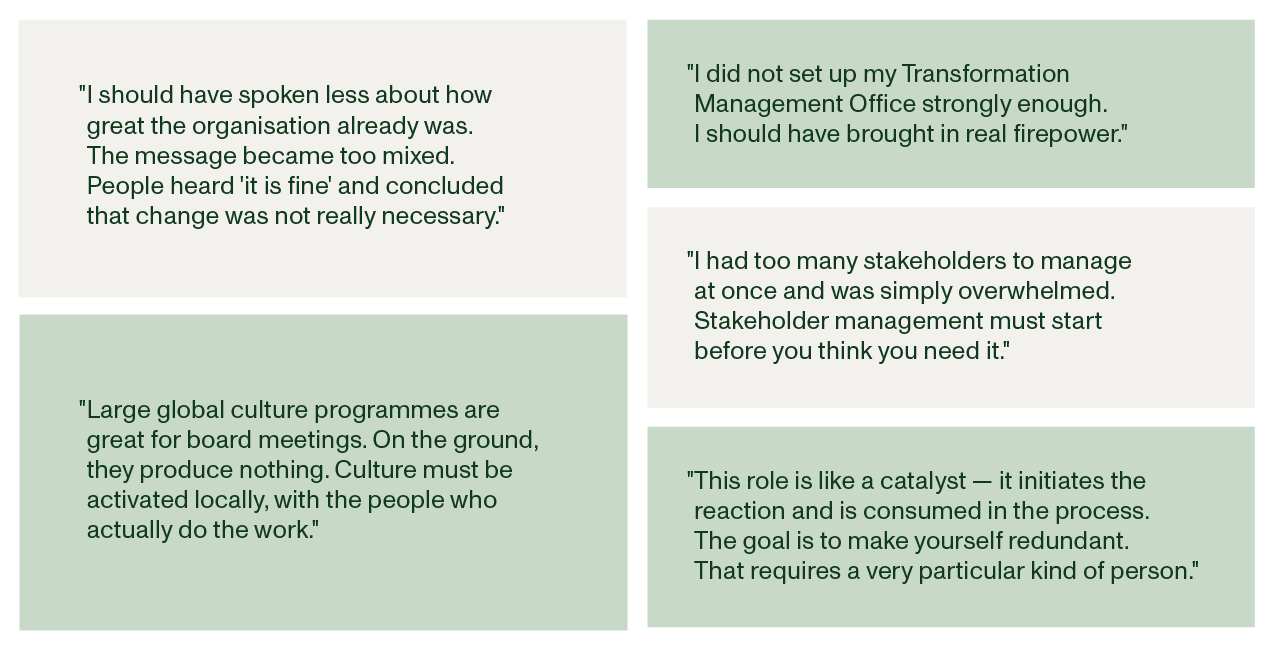
What do CTOs wish they had known before starting the job? Based on insights from practitioners, here is what surprised us most:
FGS Global works with Chief Transformation Officers, boards, communication and HR teams at exactly these moments.
Building the narrative that holds the organization together. Transformation fails when the story around it breaks down. We help CTOs develop a transformation narrative that creates a genuine sense of urgency, translates complex strategy into language that resonates at every level, and stays consistent from the boardroom to the shop floor. A strong narrative is not the packaging of a transformation. It is its steering instrument.
Equipping the leaders who carry the message. Second and third-level leaders are the most critical – and most neglected – communication audience in any transformation. We prepare them to communicate the transformation in their own words, with confidence and consistency, so that employees hear a coherent story from the people they trust most.
Creating pull, not just push. We help organizations design engagement formats that make transformation something people actively want rather than reluctantly accept – moving from broadcast communication to targeted, empathetic approaches that reach the audiences most likely to drive change forward.
Turning culture change into behavioral change. Culture programs rarely change how people actually work. We help organizations identify the specific behaviors that need to shift, design local approaches that work with teams rather than at them, and track whether change is actually happening.
Download the report:
If you have questions about the findings or would like to discuss what this means for your organization's transformation journey, please reach out to Dr. Tatiana Belgorodski, Partner – Transformation & Employee Engagement: tatiana.belgorodski@fgsglobal.com.