The most consequential issues facing us today – AI governance, the energy transition, global health, geopolitical risk – no longer stall for lack of good intentions. They stall for lack of specificity: who owns what, and who's accountable for delivering it. This year, when heads of state, senior diplomats, corporate leaders, executives, and global media convened in New York around UNGA81, the public was left grappling with geopolitical alliance shifts, questions about AI governance, and stalemates in global conflicts. To respond to these challenges and communicate progress to the audiences that matter most to our clients – regulators, investors, consumers and the public – we gathered 50 corporate, diplomatic, civil society and cultural leaders for a candid dialogue.
At FGS Global’s inaugural Vantage Point luncheon, leaders across sectors shared insights shaped through experience working across these major issues, and what they were hearing during UNGA week.
Across every table, a few conclusions kept surfacing: Commitments without specificity are no longer enough – partners want clarity and accountability. And while a majority of people say their country should cooperate to solve global problems, vague commitment no longer lands. What's being asked for now is specificity, ownership, and a clear plan to move things forward.
Setting the scene
The conversation opened with grounding perspectives from two voices with direct stakes in the challenge. Bethany Aquilina Brez, Vice President of the Office of Foreign Policy at the U.S. International Development Finance Corporation (DFC), framed the operating environment plainly: government resources alone cannot meet the scale of today's challenges. The message was straightforward – the scale of today's challenges requires private capital, and the conditions that unlock it are as much about trust and transparency as they are about financial returns.
Hon. Kwabena Mintah Akandoh, Minister of Health of Ghana, brought a different but complementary urgency. Last year, he noted, the conversation centered on plummeting funding. This year, it has moved forward – but not far enough. What's still missing, he said, is specificity: who does what, and who is accountable for it. Country ownership is the core pillar – no one understands a country's needs better than its own people, and partners must align around one plan rather than duplicate fragmented efforts. His imperative was direct: move from activism to action. Each party must define its role and come back next year ready to deliver.
From the tables
Five roundtable discussions followed organized around the most dynamic topics of the moment, and bringing together leaders from across sectors . What surfaced from each table reflected the real tensions and trade-offs each is navigating right now – alongside a levity as the groups brainstormed solutions.
Energy transition and climate finance. Clean energy technologies are advancing, but momentum is needed to translate them into real progress. The technology exists; the challenge is deployment at speed and scale.
AI, technology, and digital connectivity. The conversation was notably somber. The weight of the moment – the pace of AI development against the slowness of governance – underscored the importance of thoughtful regulation. Participants called for shared common values without overreach and stressed that maintaining open communication about risks is critical. The UN was raised as a viable framework for global AI governance.
Global health and system resilience. A disruptive year, but disruption creates opportunity. The table challenged the artificial lines drawn between health and humanitarian work, arguing they are wasteful. Power dynamics were also discussed – who has power, who needs power, and who is wielding their power in what way – and what kind of power having money and resources gives you and what kind of power having sovereignty gives you. At this inflection point, the global health leaders emblematic of this ecosystem were optimistic about what happens next. Each party agreed to get specific about what it will change.
Sport, culture, and soft power. Sports and culture can drive change at a global scale and bring people together more than almost anything else. Two open questions emerged: should major bodies like FIFA and the IOC remain siloed or coordinate more deliberately, and should the U.S. government play a stronger convening role – and if so, how do all parties align on priorities and avoid pitfalls that come with politicizing something that works precisely because it transcends politics.
Geopolitical risk and corporate reputation. U.S.-China dynamics remain a defining lens for nearly every strategic decision. Questions around what it means to be an American company, and what it means to have a secure supply chain, are no longer theoretical. Trust and credibility are critical in a rapidly shifting world – and increasingly, they have to be rebuilt rather than simply maintained.
Closing voices
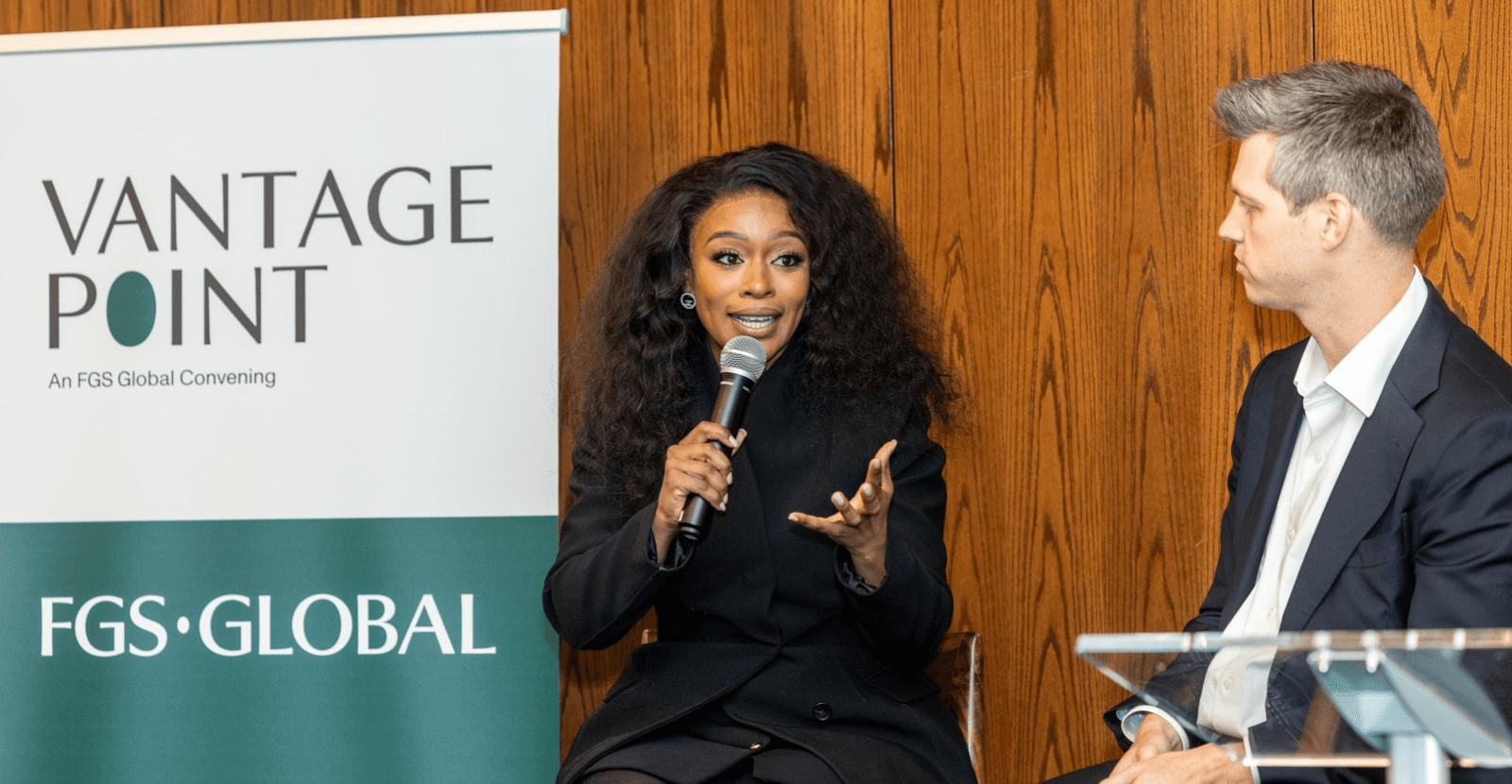
The luncheon closed with a conversation between Mick Sheldrick, Co-Founder of Global Citizen, and Nomzamo Mbatha, actress and humanitarian. Mbatha set the tone early: we live in a fractured world, but there is optimism – and nowhere was that more visible than in New York that week. Their exchange was grounded in the tension between what's working – solutions emerging from within Africa, communities finding their footing – and what remains out of reach. Mbatha was candid. Change is visible at the community level but not yet at scale.
And on the week's defining topic, she was pointed: Africa must be included in the global AI conversation. Its absence, she said, feels ominous.
What we take forward
The inaugural Vantage Point luncheon confirmed something our team already suspected: the format matters as much as the agenda. The conversations that moved were the ones that happened across sectors, between people who don't usually share a table. Ministers alongside CEOs, diplomats alongside cultural advocates, technologists alongside humanitarians.
The throughline across every table was the same: good intentions are not in short supply. What's scarce is specificity. Knowing exactly what you're committing to, who owns it, and being able to say so credibly, is the difference between a pledge and a plan.
We look forward to building on these conversations at UNGA82.
To learn more about FGS Global's UNGA offering, contact our team at UNGA@fgsglobal.com.