
One Giant Leap for Corporate-kind

Space shuttle launching into a cloudy sky with bright flames and smoke billowing below.

One Giant Leap for Corporate-kind

The Trump administration's "Ignition" space program represents the most significant recalibration of U.S. space policy since the Artemis program's inception. A $30 billion blueprint to build a permanent lunar base by 2032 is already reshaping how governments, companies and investors think about the sector. FGS Global's Space team has outlined the key trends to watch:

  • Speed is the primary currency. The plan will shelve the Gateway orbital station to redirect resources, while also compressing the timeline by an estimated 18-24 months. Additionally, an unprecedented plan for 30 robotic landings in under two years signals that the new cadence rewards rapid prototyping and iterative development. Traditional multi-year cycles risk being left behind.

  • Geopolitics is driving the agenda. NASA explicitly cited China's rival lunar program as justification for the accelerated timeline. By positioning the lunar base as a national security imperative, the administration has built in bipartisan Congressional insulation against discretionary budget cuts.

  • The transition from government to commercial is accelerating. Post-Artemis V, NASA will function as an anchor customer, opening a competitive market for lunar access. Commercial firms with reusable lander technology (like SpaceX Starship) stand to dominate, while traditional cost-plus contractors face margin pressure.

  • Permanent presence is the new benchmark. Ignition commits to continuous lunar habitation, requiring closed-loop life support, radiation shielding and in-situ resource utilization (ISRU) for water and oxygen extraction — elevating a new tier of specialized firms into strategic relevance.

To learn more, read the key insights outlined by the FGS Global Space Team, or reach out to space@fgsglobal.com.  
By the Numbers

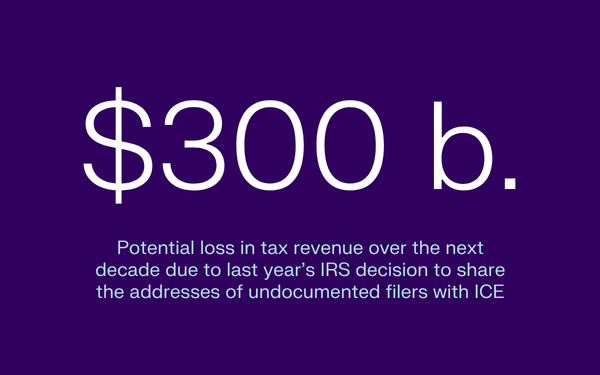
Text on a purple background stating the potential $300 billion tax revenue loss due to IRS sharing undocumented filers' addresses with ICE.

Dissident and Desist

A modern conference room with a large oval table surrounded by black leather chairs, facing large windows and a wall-mounted TV.Q1 offered a rare reprieve from activist pressure. With geopolitical tensions rattling equity markets in the first quarter, dissident hedge funds pulled back from their signature playbook, offering companies a brief window of relief. Here’s what’s happening:

  • M&A-related activist campaigns fell to 29% in Q1, well below the four-year average, as dissidents pivoted toward operational changes and capital returns.

  • Despite market turmoil, M&A activity broadly saw a surge in Q1. Global M&A transaction values rose 20% to $1.3 trillion in the first three months of the year, the strongest Q1 total on record, according to Bloomberg.

  • Global activist investor activity fell 11%, with significant declines in Europe and Asia. The U.S., on the other hand, bucked the trend by rising 3%. The retreat mirrors a pattern seen during the Covid-19 pandemic. Even the most aggressive activists tend to stand down when uncertainty looms.

  • Despite the pull-back, activists remained effective. Dissidents secured 45 board seats through 18 settlements and eight active contests remain with 25 board seats in play. Nine CEOs have departed within a year of a campaign, matching the elevated four-year average.

The lull is unlikely to last. When macro conditions stabilize, pressure will return. In the meantime, management teams and boards should use this window to examine their strategy and sharpen their narrative before dissidents come back with fresh demands.

Trust Issues

Statue of Lady Justice with scales, gavel, and law books in the background, symbolizing law and justice.The rules of competition enforcement are being rewritten in real time. On March 26, FGS Global convened top U.S. and UK antitrust enforcers for a candid discussion on where policy is headed under the current administration. Below are some of the key takeaways:

  • Federal enforcement is reorienting. Despite perceptions of a lighter touch, U.S. enforcers pushed back on suggestions that politics or lobbying have shaped their decisions. They reinforced the message that enforcement priorities reflect legal mandates, not external pressure.

  • States are the new front line. Where federal agencies pull back, state attorneys general are stepping in. With 39 states and the District of Columbia co-plaintiffs in the Live Nation case alone, state-level enforcement is no longer a secondary consideration for businesses managing antitrust risk.

  • AI is the next battleground. Regulators on both sides of the Atlantic are grappling with how competition rules apply to AI development, content licensing and algorithmic behavior. No consensus has emerged, but the direction of travel is clear: scrutiny is coming.

  • The UK is open for business. The Competition and Markets Authority (CMA) signaled a deliberately predictable and non-ideological approach, with firm nationality playing no role in competition outcomes. For multinationals navigating cross-border deals, the contrast with the U.S. posture is worth noting.

  • Media consolidation is being reframed. Regulators defended recent merger approvals as rational responses to structural pressure on local broadcasters, while flagging sports rights and streaming as emerging pressure points for antitrust scrutiny.

Read a full summary of our event, "Antitrust in Action: Enforcement Priorities and the Path Forward” on our website.

April 14, 2026
By Nedra Pickler, Irene Moskowitz and Erin Barth-Dwyer

Share

Want to see more of this in your inbox?