For European businesses with exposure to China - whether through supply chains, market access, or competitive pressure from Chinese imports - the coming weeks mark an important inflection point in the EU-China trade relationship. The diplomatic calendar is dense, but the decisions being made now will shape the trajectory of EU trade policy well beyond the autumn, and with it, the operating environment for businesses across the continent. What follows is our read of the landscape ahead.
What's at stake
EU officials have downplayed the prospects of a material outcome from the October summit – our take suggests they are right to do so. They will hope to be able to point to commitments by Beijing to continue to work towards a managed solution. But unless this is more substantive than signals currently suggest, this will have the effect of putting the ball back in Brussels’ court. It will have to decide on a course of action across several files:
The Commission can be expected to move on a number of prospective safeguard cases. These would provide some relief for EU industry (although only from rising import volumes, not artificial low pricing), do not target China explicitly and will take several months to plan and implement, which provides a runway for de-escalation.
The Commission can be expected to move forward on a possible supply chain diversification instrument. Officials have referred to a desire to ‘encourage’ EU firms in key sectors to diversify away from China, which may suggest that a first iteration could be an audit and disclosure tool rather than a formal requirement for structural change
The European Council is likely to press the European Commission to go further and table explicit ideas for a ‘resilience tool’ that could allow the EU to take targeted action on Chinese imports above defined thresholds on the model of the US 232 and 301 instruments.
The Irish Presidency will want to produce a consolidated draft of the IAA, which will require key China-facing decisions on scope and the nature of EU market protections.
The Commission can be expected to propose a number of practical changes to the trade defence toolkit, reflecting the ideas floated by a group of influential member states in June, including faster provisional duties, a move away from the ‘first come first served’ approach to trade defence measures and expanded case scopes to target multiple products.
The October talks will not resolve EU-China trade tension. The more consequential question is what Brussels does next and on that, the direction is clear: a more protective policy architecture is being built, instrument by instrument. For businesses, the priority is to map exposure to the specific measures under development and engage before positions harden. Those that treat this as a strategic planning challenge rather than a compliance exercise will be better placed than those waiting for diplomatic clarity that is unlikely to come.
For a broader read of how Beijing is navigating its simultaneous tensions with Washington, see our analysis of the US-China summit and its implications for global business.
A relationship under strain
Source: eurostat
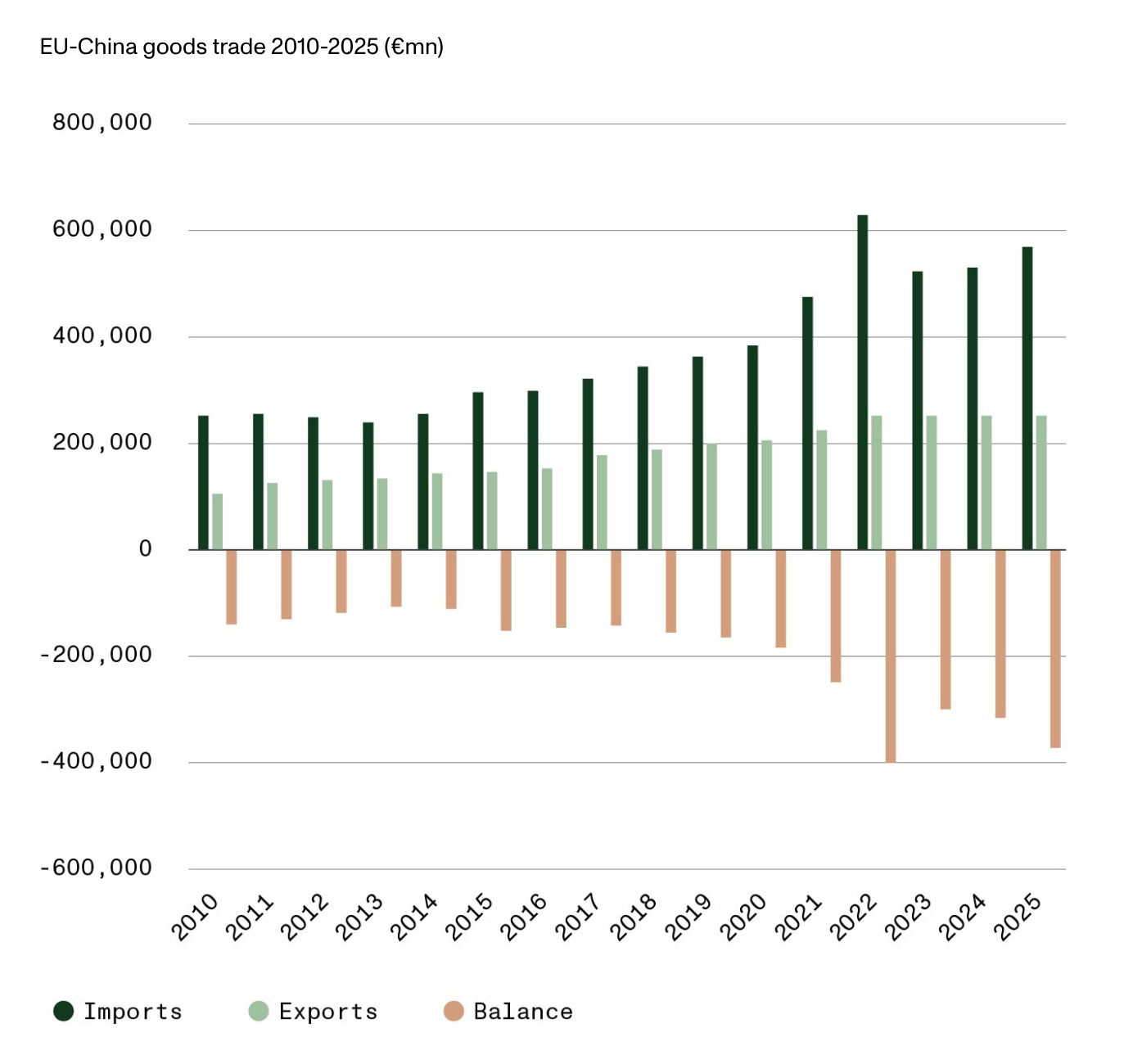
The EU-China trade relationship has been deteriorating in plain sight. The EU's bilateral trade deficit with China reached €360 billion in 2025 – a highly symbolic €1bn a day. This is the largest ever recorded; and the first year in which every single member state ran an individual deficit one – including, critically, Germany. Behind this number are key questions for European policymakers. Does this dependence on Chinese imports represent an economic security – or even national security – problem? How much of the trade imbalance is structurally driven by Chinese industrial policy in a way that makes it a legitimate target for defensive action? Is escalating trade tension politically and geopolitically sustainable?
For businesses, the questions are more immediate: is your exposure to Chinese inputs or competitors a risk that has been adequately priced in? And is the organisation prepared for a regulatory environment that is moving in a more structural and restrictive direction than previously assumed?
Part of the answers to those questions is now clear. European policymakers almost universally believe that Chinese export competition is distorted by the effects of Chinese industrial policy and is not simply a question of lagging EU competitiveness. They also believe that its impacts across the EU’s own ecosystem represents an existential threat. Unprecedented demand from industry for anti-dumping and anti-subsidy measures has seen the EU’s capacity to process and implement trade defence measures slow to a crawl. The Industrial Accelerator Act, along with key changes to public procurement policy across a range of files, have started to take the EU more decisively down the route of ring-fencing the European Union market from both Chinese inputs and certain forms of Chinese capital.
This mindset change is important, because it signals a shift from a view in which ‘trade defence’ is a question of establishing time and breathing space to restore competitiveness to one in which Chinese trade competition is viewed as fundamentally distorted by state intervention and producing excessive external dependencies that need to be unwound. The EU’s recent steel measures – which convert a tool of the former sort into a tool of the latter – are a sign of the shift.
Beijing rejects much of this analysis and its response has been to adopt its own version of this scrutiny and contingent access. These include formal protests against the proposed revision of the Cybersecurity Act, retaliatory scrutiny of European companies under its own anti-foreign sanctions legislation, and sustained pushback against EU Foreign Subsidies Regulation probes, as illustrated by the JD.com and Ceconomy investigation.
EU policymakers are acutely aware that escalation carries risk – not least because of the existing degree of dependence. When the Dutch government took control of Chinese-owned chip manufacturer Nexperia in October 2025, citing economic security concerns, Beijing responded within days with export controls cutting off roughly 70% of Nexperia's EU production. Volkswagen and Volvo warned of imminent factory closures. These object lessons will be front of mind in Brussels.
This sets the stage for the second half of 2026. Trade Commissioner Šefčovič's October trip to Beijing to meet with his Chinese counterpart Minister of Commerce Wang has been billed as an important moment for economic diplomacy solutions. It will be an early test of whether diplomacy can substitute for harder action – assuming the EU has the political will to take it. Brussels has floated the idea of new trade defence measures, including a possible supply chain diversification instrument and new safeguard measures.
The autumn diplomacy drive
The sequencing ahead of Commissioner Šefčovič's October trip to Beijing has been deliberate and dense: DG Trade's Chief Trade Enforcement Officer and Deputy Director-General Denis Redonnet visited China first in early September, to be followed by Director General Ditte Juul Jørgensen's own Beijing trip later that month, and an INTA parliamentary delegation making the same journey - all before Šefčovič and Minister Wang Wentao meet at ministerial level in October to take stock.
The EU has also provided a steady flow of indications of the actions it might take if China does not – or cannot – act to address EU concerns. These include:
New safeguard measures to cap Chinese (and other) imports, with chemicals emerging as the sector where the case for action is most urgent, given the combination of import surges, strategic dependency, and a domestic industry under severe pressure.
A possible supply chain diversification mechanism designed to incentivise EU importers to restructure supply relationships proactively in the EU's most strategic sectors, addressing excessive reliance on a single country for critical imports.
An update to the existing trade defence repertoire: anti-dumping, safeguards, anti-circumvention including faster measures, wider targeting of measures on multiple elements of a value chain and a wider set of union interest tests more explicitly targeted at economic security.
A wider scope for the Industrial Accelerator Act that would extend implicit restrictions on China to additional sectors. The Cybersecurity Act 2 would do the same for critical digital infrastructure, through its high-risk provider designation framework.
In the days before Šefčovič boards his plane to Beijing, President von der Leyen is expected to deliver her State of the Union address, and with it a clearer signal of where the Commission's economic security agenda is heading. How she frames the ask for Beijing – and the action the EU will be willing to take – will be important to watch.
This raises two questions: does Beijing see these as material risks – and what might it do to avoid them? The Commission is actively exploring whether Beijing can be persuaded to voluntarily curb its exports to Europe, drawing explicitly on precedents from the 1980s when Japan and South Korea agreed to cap shipments of cars, steel and electronics. Such an agreement would be highly dubious under WTO law and entirely dependent on China to deliver. It is a measure of the EU’s urgent need for a de-escalatory solution that it is being considered at all.
Beijing will point to commitments in its own 15th Five Year Plan to reduce excess capacity, curb “involution-style” competition (excessive competition in which firms cut prices and margins without generating corresponding gains in productivity or innovation) and expand household consumption as economic priorities for 2026. But European Commission officials will find it difficult to sell these commitments as a meaningful response on the time frames required.
In part for these reasons, the bar for October has been set deliberately low. In her first appearance before the European Parliament's Trade Committee on September 2nd, incoming DG Trade Director General Ditte Juul Jørgensen described the goal as a "proof of concept". There was no talk of a deal. What the Commission is working towards is an outline sufficient to demonstrate that structured dialogue can produce movement. Member states have given the Commission until mid-October to show tangible results in sectors they consider most sensitive: chemicals, cars, medical devices and pharmaceuticals, and advanced machinery. In an interview with Euronews earlier this month Šefčovič said that if the talks fall short, "there will be a strong political movement to push for harsher measures". This is certainly true, but it is a negotiating position rather than a clear description of EU intent.
The view from Beijing
Beijing’s approach to the current EU-China trade standoff reflects a combination of strategic confidence, domestic political constraint and a continued preference for disputes to be managed through consultation, practical solutions for concrete issues and what it terms an “upward balancing” of investment and trade. The latter includes greater European exports to China such as ASML lithography equipment, which is an obvious political sensitivity.
China rejects the European contention that its sliding industrial competitiveness can principally be explained by subsidies, distorted prices or structurally unfair competition. The Chinese side argues that its subsidy approach is widely used internationally and does not create excess capacity. Beijing attributes China’s export strength primarily to innovation, intense domestic competition, economies of scale and global demand. It argues that trade surpluses cannot by themselves constitute evidence of overcapacity.
An editorial published in early September by the Global Times, which Beijing allows to express opinions more sharply than its official rhetoric, argued that Europe doesn’t have the capacity to wage a trade war against China, given Europe’s structural issues and economic challenges. It signaled a willingness to absorb a serious deterioration in economic and trade relations.Instead, it highlights the minimum price undertaking established by Volkswagen in Anhui in 2025 as an alternative to EU EV duties – although whether such arrangements are practical at any scale is an obvious question. The confidence in asserting a tolerance for weaker trade ties has some structural basis: Chinese firms increasingly regard Europe as one market among many. ASEAN exports now exceed EU exports at $665 bn vs $560 bn.
As has been demonstrated in past negotiations with both the EU and the US, Beijing is unwilling to accept external pressure for wholesale changes to the fundamentals of its development model as the price of market access. Chinese companies expanding internationally have strong incentives to preserve European market access. But like officials in Beijing they also question whether the EU will ultimately summon the political will for a policy as restrictive as the US model, and that scepticism, combined with the increasing politicisation of market access, weakens any strong incentives for Beijing to make big concessions.
Picture by Zalfa Imani