Introduction
William Klein, Consulting Partner, Berlin
On September 24, Presidents Donald Trump and Xi Jinping will meet in Washington, DC, for their second summit of the year, with further engagements possible at the November APEC and December G20 gatherings. This cadence of leader-led diplomacy has put guardrails around the U.S.-China relationship, holding in place the truce struck during their 2025 meeting in Busan, South Korea. Sunday’s pre-summit meeting between Vice Premier He Lifeng, Treasury Secretary Scott Bessent, and U.S. Trade Representative Jamieson Greer – reportedly covering AI, tariffs, and critical minerals – reflects both sides’ interest in arriving at the summit ready to move the dialogue forward in tangible ways.
A reaffirmation and extension of the Busan truce – under which the United States agreed to hold off further tariff hikes in exchange for China resuming export licenses for critical minerals – is the most likely, and most positive, outcome this week. The two leaders will also likely reaffirm their commitment to the long-delayed Boards of Trade and Investment announced at the last summit. Both sides see value in exploring guardrails around AI, but fear that any understanding could constrain themselves more than the other side, likely limiting progress beyond a stated commitment to engage on the issue.
Yet this leader-led stability rests on thin institutional footing. Both countries’ security and economic establishments keep seeking ways to cut dependence on the other while building their own competitiveness and leverage. This leaves companies with a stake in both markets facing the challenge of identifying where interdependence will hold, and where decoupling will continue to deepen. A clear delineation will likely remain elusive: the line is drawn by political perception, which shifts with threat assessments and a willingness to bear the costs of decoupling or derisking.
Our colleagues examine this arc from Beijing to Washington sector by sector – from the American midterms shadowing the summit, to trade, AI, energy, critical minerals and Iran – to assess where that border is likely to hold, and where it is already moving. The answer also matters far beyond the two capitals, as underscored by our colleagues around the world, who each assess what the summit means for their region.
Politics and policy in the U.S.
Brett O'Brien, Partner, Washington D.C. and Sarah Trister, Managing Director, Washington D.C.
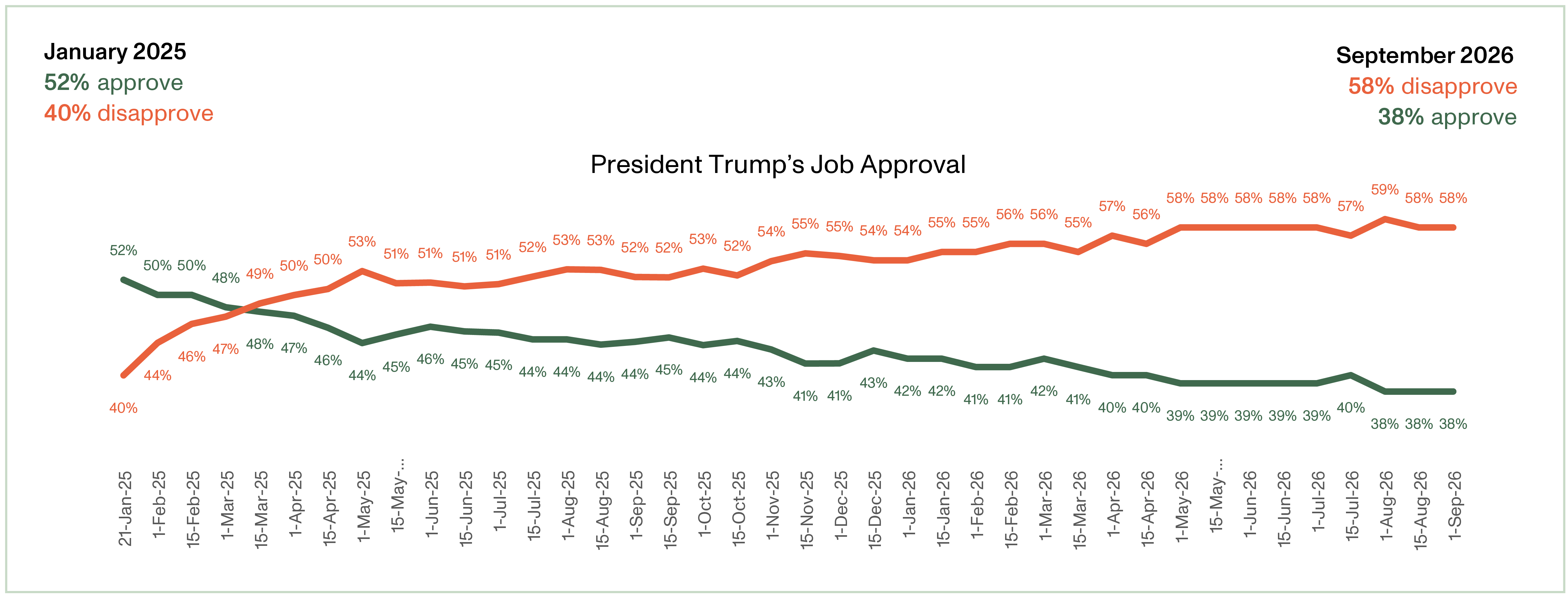
The Trump-Xi meeting comes 40 days before American voters head to the polls to decide who will control Congress for Trump’s final two years in office. The specter of the election looms large as Trump faces voter concerns about affordability, a low approval rating, and the ongoing, and unpopular, war in Iran. Republicans hope a successful summit will boost Trump’s America First message and highlight his ability to make deals favorable to the U.S. going into the election. But the climb will be steep. Democrats view Trump’s ongoing discussions with China as a vulnerability – they will highlight the lack of progress toward an enduring deal and expose weak points in Trump’s trade agenda – arguing that tariff policies have hurt local economies and sectors.
 A change in power in one or both chambers of Congress is unlikely to lead to a softening in rhetoric or policy toward China. Democrats have largely embraced policies that seek to limit the transfer of key technologies to China, restrict the ability of Chinese companies to sell certain products into the U.S., and highlight human rights abuses. Instead of less scrutiny on China, expect Democrats to focus on exposing alleged corruption surrounding Trump Administration actions toward China and other countries, criticize Trump trade and national security policies, hammer Trump and congressional Republicans on the cost of the Iran war, and establish a contrast to the America First approach by repairing relationships with U.S. allies. Companies that appear close to the Trump Administration will find themselves under a microscope.
While Americans traditionally base their votes on kitchen table issues like housing and the economy, Trump’s aggressive trade agenda combined with the ongoing impact of the Iran war place foreign policy in the spotlight in the weeks before the election – making the meeting between Trump and Xi more consequential than ever for an American President looking to solidify his legacy.
Commercial relations and trade
Paul Yang, Partner, Hong Kong
The diplomatic posture between the U.S. and China following Trump’s visit to Beijing has been one of managed stability, though the operational reality remains one of persistent trade friction. Since the May summit, Beijing has visibly expanded its countermeasure toolkit against the United States. Recent measures include stringent export controls on drones, sanctions on U.S. entities under the Anti-Foreign Sanctions Law, and a national security investigation into U.S.-branded office equipment, though its legal framing covers all foreign software. Washington has moved in parallel: in June, the Department of Defense added 65 entities to its Chinese Military Company list, bringing the total to 188 companies and targeting major consumer and technology firms across AI, electric vehicles, biotechnology, and robotics. Both sides’ actions appear to suggest calibrated escalation strategies as they prepare for the year’s second presidential summit later this month.
While discussions on the Boards of Trade and Investment have advanced little since May, both sides continue to engage actively on potential areas for commercial collaboration. This includes finalizing a framework for reciprocal tariff reductions, narrowing a list of “non-sensitive” products and sectors, such as agriculture and aviation, that would be shielded from future trade restrictions, and the possible inclusion of business leaders within the Chinese delegation. Should this occur, it would signal Beijing’s willingness to support continued investment and commercial ties with the United States, while implicitly acknowledging that strategic competition will remain the defining feature of the bilateral relationship between the world’s two largest economies.
Accordingly, the commercial agenda for the upcoming Xi-Trump meeting is expected to remain centered on two areas: low-sensitivity pragmatic cooperation and structural contention. Tangible outcomes are anticipated in agriculture, conventional energy, and green and low-carbon sectors, areas notably absent from formal announcements at the May summit. With the Busan arrangement likely to be extended, the summit is expected to reinforce rather than reset the commercial relationship.
Technology and AI
Sarah Trister, Managing Director, Washington D.C. and Doug Bove, Managing Director, Washington D.C.
Calls by leading American AI companies to slow the rate of development of frontier AI have exposed the deeply entrenched competition between the U.S. and China, with both Trump and Xi dismissing concerns in favor of gaining a competitive edge. Trump has framed the ongoing competition as a zero-sum game, while Xi has taken a more nuanced approach, saying that AI technologies should be “shared and governed by all countries.”
Expectations for any breakthrough on technology should be set low. Beijing’s likely objective is to fend off additional restrictions but offer little in direct concessions on AI in return. At most, expect an announcement on process, while further restrictions on AI and chip access continue to move through Congress and the executive branch. Businesses should expect continued skepticism among policymakers about Chinese models, from both a competition and national security standpoint.
Recent accusations that Chinese AI model makers have undertaken industrial-scale distillation have been met by Treasury Secretary Scott Bessent’s threat to sanction culpable Chinese firms and Congress’s proposed Deterring American AI Model Theft Act to protect U.S. AI capabilities. Two key House committees have also opened an investigation into the national security risks posed by Chinese AI models, and legislation has been offered to restrict U.S. government use of these models. While the path to regulatory action seems uncertain, U.S. companies utilizing Chinese AI will face ongoing scrutiny.
In parallel to the bilateral track, both governments are building rival blocs on AI. China launched the World AI Cooperation Organization in Shanghai on July 16 with 29 signatories, pitching open-weight models and training to the Global South; the U.S.-led Pax Silica reached 25 declaration signatories by August. Whether the two sides can put aside competition to face difficult questions about security is an open question.
Energy
Catharine Ransom, Partner, Washington D.C. and Asaf Nagler, Managing Director, Washington D.C.
Both governments face domestic pressure centered on energy, from high prices at the pump to the race for AI dominance. A wide swath of energy-related dynamics are at play heading into September 24.
On AI infrastructure, both countries are jockeying to lead the global AI race but are taking different approaches. China continues to move quickly at scale on clean energy, while U.S. policy is leaning on natural gas, the promise of new nuclear energy sources, and the removal of barriers to grid interconnection.
Supply chains present a parallel tension. China leads globally on batteries and solar PV; while the U.S. solar market has slowed, U.S. solar manufacturing has grown 700% since 2022. While the U.S. sees increased demand for data centers, it is trying to fend off Chinese equipment with new restrictions on connecting Chinese electrical equipment to the bulk power grid, Foreign Entity of Concern requirements, and 45X credits to build U.S. solar, critical minerals, and battery supply chains.
The fossil fuel picture is similarly complex. U.S. LNG exports averaged a record 17.4 billion cubic feet per day in the first half of 2026, but China has placed tariffs on U.S. crude and LNG. Closure of the Strait of Hormuz drove China’s crude imports to their lowest level since 2016 in June, forcing drawdowns of China’s reserves. The U.S. faces its own pressures: gasoline remains well above $4 per gallon, with affordability a top voter concern ahead of November elections. The Administration’s release of oil from the Strategic Petroleum Reserve (SPR) in March brought only modest relief and pushed the SPR to its lowest level since 1983.
A major strategic realignment is likely not afoot, but there may be appetite for expanded U.S. LNG and crude purchase commitments from China, building on the four LNG vessels that sailed to China within days of the May summit.
Critical minerals
Heather Tory, Partner, FGS Longview, Toronto and Will Thompson, Managing Director, Washington D.C.
The Trump-Xi summit will take place 47 days before the expiration of China’s one-year suspension of export controls on many critical materials, and is likely the last opportunity for the leaders to discuss whether the suspension is extended, modified, or allowed to lapse. The summit will also shape near-term decision-making by companies and investors, and send key economic signals for sectors reliant on critical minerals, including energy and defense.
Since the May summit, both sides have hardened their positions rather than build on the diplomatic opening provided by the suspension. China blacklisted MP Materials and USA Rare Earth in June, targeting the two firms at the center of Washington’s efforts to build a domestic supply chain. The U.S. responded with allied supply agreements, a $12 billion stockpile initiative, and a U.S.-EU critical minerals action plan, all of which China has read as a signal for longer-term decoupling and answered with further tightening of exports in August. Each side’s defensive investments are being interpreted by the other as offensive escalation, producing a cycle that the May framework failed to interrupt.
The practical consequences are already visible – firms are halting trade out of fear of government retaliation or retribution. By early September, Chinese suppliers were freezing U.S. shipments voluntarily, even where valid export licenses existed. U.S. imports of yttrium remain at roughly half their 2024 level. Some American buyers have waited more than six months for approvals. Regulatory permission no longer guarantees that material will move, creating difficulties for manufacturers operating on tight schedules.
Progress on building allied supply chains is real but years from reaching scale. The U.S. remains heavily import-dependent due to China’s control of the bulk of critical minerals processing, giving China structural leverage that U.S. stockpile initiatives cannot presently offset. The most likely summit outcome is a narrow truce extension that eases immediate pressure without resolving the structural rivalry.
Iran
Iesha Carter, Senior Associate, Washington D.C.
The latest escalation in the U.S. economic pressure campaign against Iran has stopped short of targeting major Chinese banks, despite China’s central role in Iran’s oil trade. The U.S. has instead targeted financial and commercial networks facilitating Iranian transactions, while warning larger Chinese lenders of potential secondary sanctions. Targeting major Chinese banks could increase pressure on Iran, but would risk Chinese retaliation and further complicate an already difficult bilateral economic relationship.
That leaves a potentially powerful but escalatory source of U.S. leverage unused as Trump and Xi prepare to meet. Still, Iran is likely to remain secondary to the economic issues at the center of the summit. While both countries have an interest in ending the Iran conflict, their incentives are asymmetric. The U.S. faces mounting economic and political pressure from the war ahead of the November midterm elections. China would also benefit from restored energy and shipping flows, but has less urgency given its greater capacity to withstand the disruption through domestic production, strategic reserves and diversified supply. De-escalation is therefore desirable for China without necessarily being an overriding priority.
With the U.S. having more to gain from a near-term resolution, securing meaningful Chinese support on Iran would likely require concessions elsewhere in the relationship, a posture that does not seem to be likely on the U.S. side – especially given that China’s ability to materially alter Iran’s calculations may itself be limited.
The summit will therefore be worth watching less for a breakthrough on Iran than for any indication that the conflict is beginning to alter the broader U.S.–China relationship. A Chinese call for de-escalation, alongside continued U.S. restraint toward major Chinese banks, would largely preserve the bilateral economic détente. More consequential would be substantive Chinese commitments on Iran or, conversely, U.S. willingness to extend its pressure campaign deeper into China’s financial system and accept possible exposure beyond energy and shipping. Absent such a shift, the summit is unlikely to alter the near-term outlook, with elevated energy, freight and insurance costs likely to persist.