
Divide and Conquer?

A person holds a magnifying glass over a digital Earth with environmental icons and data visualizations surrounding it.

Divide and Conquer?

Across the globe, societies are grappling with deepening divisions and fading trust in institutions. Here's what you need to understand first: the post-war rules-based order that governed international relations for 75 years has fragmented.  It’s being replaced by transactional relationships and strongman leadership—not shared values or institutional cooperation.  As one of our experts put it: "We're shifting from 'What are our shared principles?' to 'What can you do for me?'"

FGS Global’s new Radar report reveals these shifts, drawing on insights from 175 senior leaders and polling nearly 20,000 people to identify the structural forces shaping the year ahead:

  • Splintered realities fuel distrust. Political, generational and social rifts are intensifying. 76% say their country feels divided, while 74% believe their political system serves a powerful elite. Trust in government, media and public services is eroding, creating fractured information environments.

  • Crisis of confidence drives populism. Pessimism and impatience for action are surging, especially on affordability and immigration. 68% say political systems need fundamental reform and many are open to disruptive leadership, even as concerns about instability persist.

  • Two economies emerge. A “K-shaped” recovery benefits high earners and tech, while most households face stagnant wages and rising costs. 45% feel worse off than a year ago; 80% say taxes fall too heavily on working people.

  • Influence shifts. Trust in traditional authorities is collapsing, with influence migrating to decentralized, digital and peer-driven platforms. 61% say mainstream news cannot be trusted; 34% trust AI more than politicians.

  • AI adoption accelerates, but so does concern.  While business leaders anticipate productivity gains, regulatory frameworks are lagging and concerns about job displacement and energy costs are mounting. 71% want AI companies to pay higher taxes to offset energy costs.

To learn more, download the report or sign up for future FGS Global Radar reports, visit the FGS Global Radar webpage.
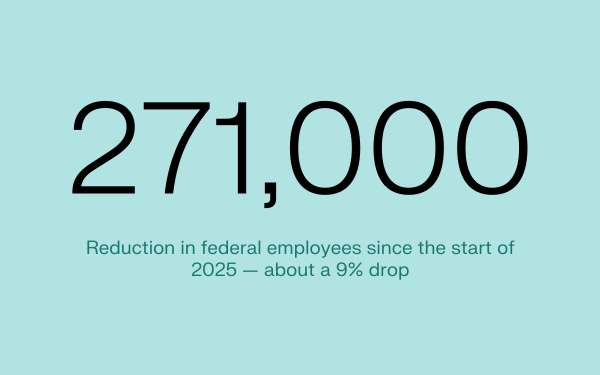
By the Numbers

Large black number "271,000" on a light blue background with text below noting a 9% reduction in federal employees since the start of 2025.

Regional Reset

Wavy flags of the United States and Venezuela combined, showing elements from both flags with stars and stripes, in a blended design.The capture of Nicolás Maduro by U.S. forces has sent shockwaves through the Americas, triggering a scramble for power and new risks for global markets. As the region recalibrates amid fragmented security, contested leadership and shifting alliances, FGS Global’s experts are unpacking what’s at stake for governments, businesses and investors. 

In a recent webinar entitled “Power Shifts in the Americas: Venezuela and the New Hemispheric Order,” retired Gen. Laura Richardson, who most recently served as the commander of the U.S. Southern Command that includes Venezuela, and our very own Nedra Pickler explored these geopolitical implications. Key insights include: 

  • Security risks are rising across the region. By targeting transnational criminal networks and supporting stabilization, the U.S. aims to help Venezuela restore functioning governance, which will benefit neighboring countries and help address migration and security challenges.

  • This action opens the door for international investment. Renewed cooperation in Venezuela’s energy sector could have positive effects on global markets and create new opportunities for international stakeholders—though production limits and infrastructure challenges will restrict short-term market impact. 

  • The next several months will be pivotal. Stakeholders should closely monitor the implementation of the transition plan, shifts in regional alliances and emerging opportunities and risks for global businesses operating in or with the region.

For additional insights, read the full memo, U.S. Intervention in Venezuela Reshapes Hemispheric Security, Energy, Competition and Regional Alignment, or reach out to geopolitics@fgsglobal.com for further support.

A Strained ASEAN

Boats docked along the Mekong river at sunset, with silhouetted mountains in the background and a golden sky.Following a volatile 2025, Southeast Asia is set for another politically charged year. Governments are under pressure, yet increasingly limited in their ability to act. Fragile coalitions, public skepticism and crisis-driven decision-making are crowding out long-term reform in favor of short-term stabilization. 

While 2026 is free of major national elections across the region’s largest economies, cost-of-living pressures, trade volatility and regional security risks continue to shape political debate. Thailand faces the prospect of snap elections, while Malaysia is preparing for key state polls and Indonesia’s leadership is confronting mounting tests of public trust. 

At the regional level, geopolitics remains elevated. Border clashes between Thailand and Cambodia, the expansion of transnational scam networks along the Mekong, and unresolved maritime disputes are blurring the line between domestic and foreign policy. The Philippines’ ASEAN chairmanship may bring a more forthright diplomatic tone, but 2026 will be a stress test for ASEAN’s cohesion.

The primary risk in 2026 is not abrupt political change but constrained policymaking capacity. Fragile coalitions, public skepticism and crisis-driven governance limit governments’ ability to pursue long-term reforms, favoring short-term stabilization over structural solutions. Economic pressures, especially amid weak household consumption, high debt burdens and exposure to shifting US trade policies, compound this challenge, particularly in Thailand and Indonesia. 

The danger is cumulative: widening execution gaps, longer reform timelines and political bandwidth increasingly spent managing risk rather than driving growth.

For more stories like this from our experts in the region, subscribe to FGS Global’s Asia In Context newsletter.

January 13, 2026
By Nedra Pickler, Irene Moskowitz and Erin Barth-Dwyer

Share

Want to see more of this in your inbox?