The politics of cross-border deals today
Spotlight on Brussels (EU)
Executive summary
The Commission is fast-tracking its merger guidelines overhaul to 2026, injecting competitiveness, security and resilience into the heart of competition policy. Our survey shows 71.8% of Brussels stakeholders support this broader framework, signaling acceptance of merger control as a tool for advancing EU strategic objectives.
With more than 200 filings since its inception, the Foreign Subsidies Regulation (FSR) is still finding its footing—and dividing opinion. While 46.2% believe it effectively addresses subsidy distortions, 50% view it as discouraging foreign investment, a tension the Commission might address in its forthcoming review of the regulation.
Member States’ grip on national security is keeping FDI screening fragmented, despite strong stakeholder support for deeper EU involvement. While 56.4% of respondents favor greater EU powers and 77% support harmonized sensitive sector lists, FDI screening is likely to remain fragmented, requiring dealmakers to navigate jurisdiction-specific requirements.
Recommendations: How to navigate the EU public-political landscape
Assess how transactions affect broader EU strategic objectives, such as competitiveness or supply chain resilience, as these parameters are increasingly set to be scrutinized within the Commission’s merger review framework. While the Commission is unlikely to create separate tests for these considerations, they are being incorporated into existing competition assessments and may influence how deals are evaluated.
Initiate pre-notification discussions early for transactions involving non-EU government contributions, particularly in cases with complexity or potential subsidy concerns. With FSR guidelines expected in January 2026 and a regulatory review by July 2026, early engagement will be critical to navigating evolving enforcement practice.
Prepare for a patchwork of national FDI screening regimes rather than harmonized EU-level requirements. While the revision may introduce some common elements, Member States will retain primary authority with jurisdiction-specific approaches, requiring tailored compliance strategies for cross-border transactions.
Control the narrative around your transaction from the outset. Address emerging regulatory sensitivities directly and connect to EU priorities to build support for your transaction: if applicable, outline positive technology inflow elements to the EU in FDI cases to proactively meet an evolving debate about instituting technology transfer requirements. In merger cases, highlighting arguments around scale and competitiveness can be helpful. Well-crafted messaging that anticipates concerns and positions deals within EU strategic priorities can materially influence regulatory and political perception.
EU merger control: Recalibrating competition policy for strategic priorities
The European Commission’s approach to merger control might turn out to be undergoing the most significant transformation in decades. When Commission President Ursula von der Leyen tasked Executive Vice President Teresa Ribera with modernizing competition rules at the start of this mandate, the review of merger guidelines became part of a broader effort to align economic policy with Europe’s evolving strategic concerns. The reform process has gained considerable momentum under political and industry pressure, with the Commission moving forward its target completion date from late 2027 to 2026. Our survey of Brussels-based stakeholders suggests receptivity to this evolution: 71.8% of respondents agree that EU merger control should play a greater role in supporting broader EU policy objectives, indicating acceptance of a framework that extends beyond traditional competition concerns.

Competitiveness has emerged as the defining priority of the new Commission mandate, permeating policy discussions across virtually every domain, and merger policy is no exception. With 62.8% of survey respondents believing competitiveness should carry greater weight in merger assessments, there is clear support for reconsidering how consolidation is evaluated. The case for enabling “European champions”—large-scale European companies capable of competing with American and Chinese rivals—has gained traction, particularly in sectors where fragmentation may undermine global competitiveness. This debate is not new, but it has intensified considerably under the current mandate. While tensions remain, with some arguing allowing consolidation to build scale risks reducing competition within the Single Market, the forthcoming merger guidelines should provide greater clarity on how the Commission intends to balance the pursuit of competitive scale with the preservation of competitive dynamics.
Security and defense considerations are emerging as equally influential factors in merger assessments. Our survey indicates that 55.1% of respondents believe security and defense should have greater influence on merger decisions—a shift that mirrors broader policy developments following Russia’s invasion of Ukraine. The Commission’s forthcoming review of the proposed joint venture between Thales, Leonardo and Airbus will offer an early test of how these priorities will be balanced. German satellite manufacturer OHB has raised concerns about the transaction, setting up a case that will likely establish important parameters for evaluating future defense consolidation and clarify how the Commission weighs security imperatives alongside traditional competition considerations.
Resilience, while ranking lower in our survey with 29.5% of respondents viewing it as a priority, has become more prominent in Commission thinking than these figures might suggest. Competition Chief Teresa Ribera has indicated that resilience may “become increasingly relevant” in evaluating mergers. The Commission’s in-depth investigation into Chinese-backed MMG’s $500 million acquisition of Anglo American’s nickel business—centered on concerns about Europe’s security of supply for ferronickel—demonstrates this is already being operationalized.

As the Commission aims to finalize its revised guidelines in 2026, dealmakers will need to navigate not just competition law, but how transactions intersect with Europe’s broader strategic agenda.
Foreign Subsidies Regulation: Two years in, still finding its footing
The Foreign Subsidies Regulation introduced a new notification requirement for transactions where the parties have received financial contributions from non-EU governments exceeding certain thresholds. Despite over two years of implementation, the tool remains in its early stages of development. Nonetheless, activity levels have been substantial: over 200 transactions have been notified since the regulation came into effect.
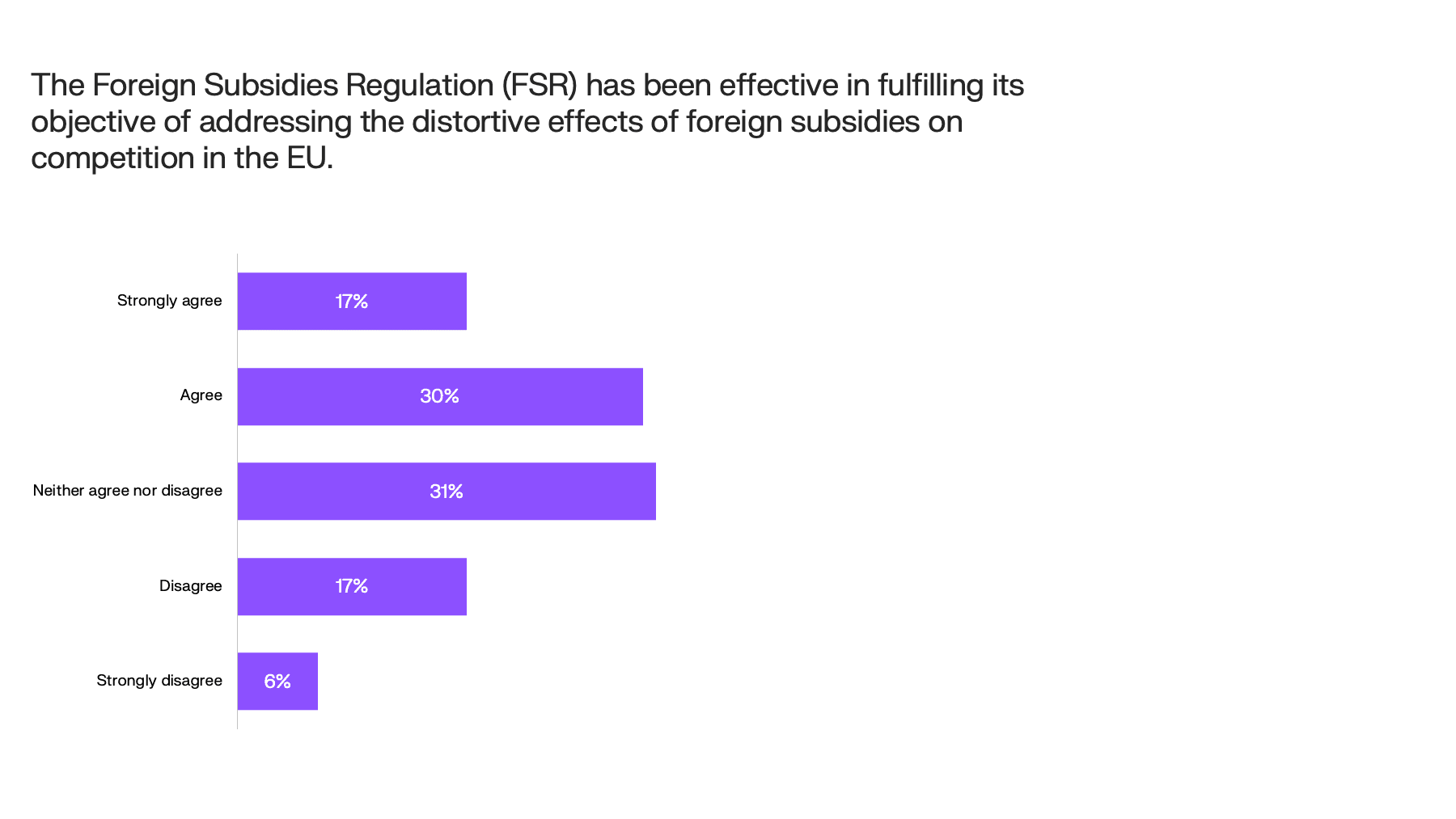
Our survey reveals divided perspectives on the regulation’s impact. While 46.2% of respondents believe the FSR has been effective in fulfilling its objective of addressing the distortive effects of foreign subsidies on competition in the EU, 50% also believe the regulation discourages foreign investment in Europe. This tension reflects broader concerns about whether the tool strikes the right balance between protecting competitive conditions and maintaining Europe’s attractiveness for international capital. China has loudly branded the FSR an investment barrier, even though no in-depth M&A probes have targeted Chinese firms and several Chinese-backed deals have cleared Commission review. Beijing’s objections seem rooted less in merger oversight and more in the Commission’s heightened scrutiny of Chinese entities under the regulation’s public procurement rules, where Chinese companies have faced far more pressure than in M&A cases.

Drawing definitive conclusions about the Commission’s approach to FSR cases remains premature. The institution itself is still developing its enforcement practice and interpretative framework, which is set to become clearer in the coming months. With limited case practice available for guidance, the Commission is finalizing guidelines on the FSR, targeted for publication in January 2026. These guidelines aim to clarify how the Commission intends to apply key provisions of the regulation, potentially reducing uncertainty for dealmakers navigating the notification process.
Additionally, the Commission must complete its first review of the FSR by July 2026, a process it has already initiated through a public consultation that concluded in November 2025. This review may lead to adjustments, with some stakeholders already calling for changes to the notification thresholds, arguing they are set too low and capture an excessive number of transactions, creating disproportionate administrative burden. The Commission itself is also considering procedural reforms, including the introduction of Phase I conditional clearances, currently impossible under the FSR, which requires Phase II investigations before remedies can be offered.
EU FDI screening: Incremental harmonization amid national sovereignty concerns
The EU FDI Screening Regulation, which entered into force in 2020, established a cooperation framework for Member States to coordinate their review of foreign investments that may affect security or public order. In 2024, the Commission proposed revising the regulation to introduce greater harmonization, notably by requiring all Member States to establish FDI screening mechanisms with specific minimum requirements.
Our survey indicates substantial support for deeper EU involvement: 56.4% of respondents believe Member States should cede more powers to the EU for reviewing foreign direct investment cases with a European dimension or affecting multiple Member States. However, the legislative process has revealed the limits of Member States’ willingness to transfer authority in an area they view as core to national security.

The revision, currently in trilogue negotiations and looking at possible finalization by year-end, has been constrained by Member States’ determination to maintain control. While the European Parliament sought to grant the Commission investigative and decision-making authority to review foreign investments impacting multiple EU countries, the Council appears likely to reject binding Commission powers. Based on the latest negotiations, the Commission may instead receive enhanced advisory powers in certain sensitive cases, a more modest step than initially envisioned.
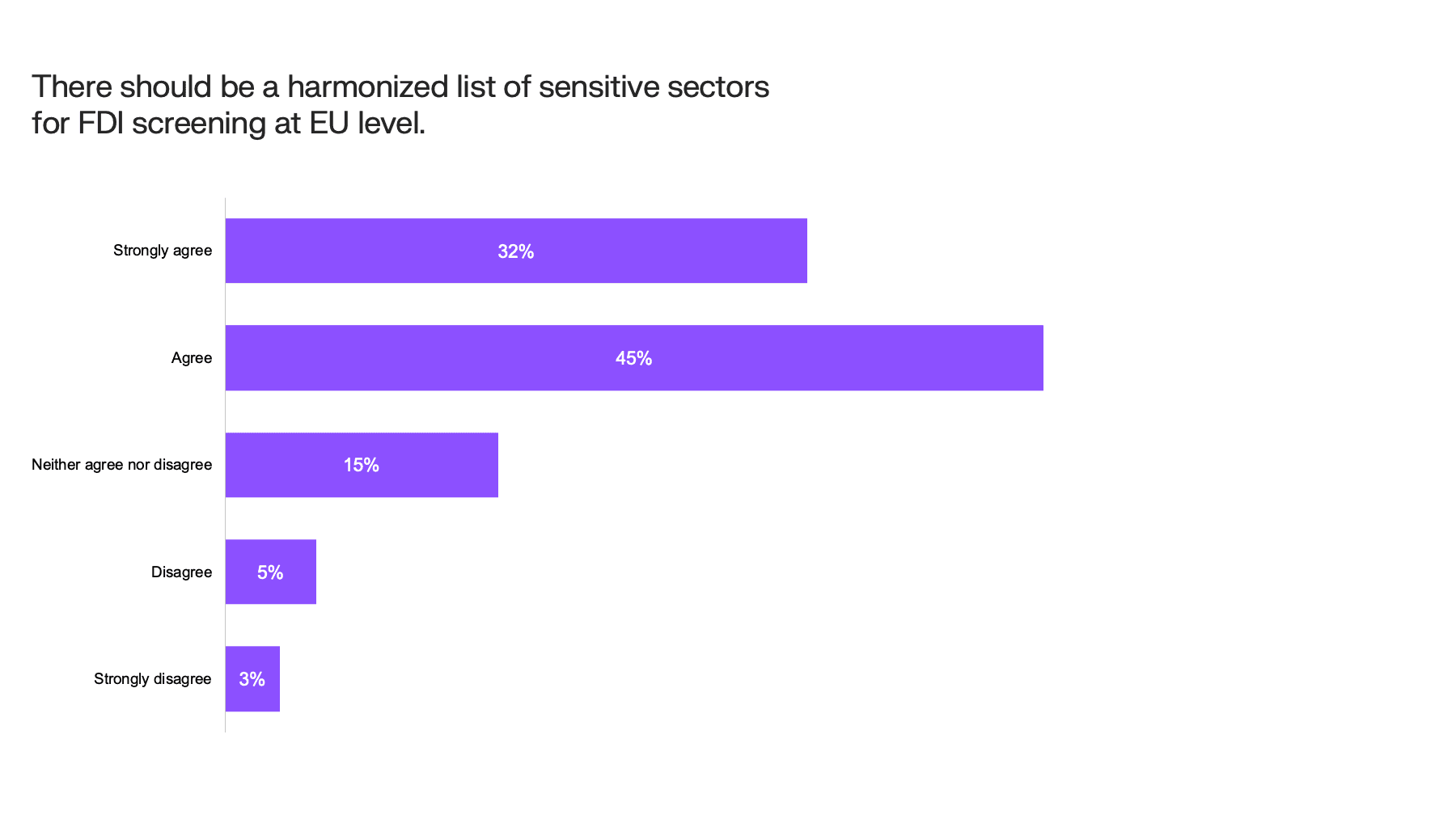
One of the Commission’s key proposals, introducing a harmonized list of sensitive sectors for FDI screening, has garnered strong support in our survey, with 77% of respondents in favor. However, the final text remains uncertain. Parliament has advocated for extending the list of strategic sectors, while Member States have sought to narrow it and avoid making screening in these sectors mandatory, preferring that countries take these sectors into consideration when designing national regimes.
The outcome is clear: meaningful harmonization of FDI regimes across the EU remains constrained by Member States’ reluctance to cede sovereignty. Dealmakers should expect new FDI screening mechanisms to emerge in Member States that currently lack them, but the regime will remain fragmented, requiring careful attention to jurisdiction-specific requirements.
Nonetheless, the Commission appears increasingly willing to challenge excessive use of FDI screening powers. The Commission recently initiated an infringement procedure against Italy, questioning Rome’s use of Golden Powers that led UniCredit to withdraw its bid for Banco BPM—an unusual application of investment screening to a purely domestic transaction. This signals the Commission’s readiness to establish boundaries on how Member States exercise their review powers, even as they retain primary authority over FDI screening.