The politics of cross-border deals today
Spotlight on the United States

The return of Donald Trump as President – this time with more aggressive trade and investment policies – made for a tumultuous 2025. The new Administration’s “America First” agenda mixed protectionism with a thirst for deals that reflected heightened national security concerns among policy elites and incentivized dealmakers to frame transactions as “wins” for the United States. Simultaneously, national security reviews by the multiagency Committee on Foreign Investment in the US (CFIUS) were increasingly seen by our survey respondents as subject to external influences.
Executive summary
Tougher screening measures sought: After four years of President Biden and congressional Republicans seeking to outdo each other in the pursuit of tough foreign investment policies, especially vis-à-vis China, American opinion leaders demonstrated that they want even more stringent controls. Nearly 89% of survey respondents shared this sentiment, with fewer than 7% favoring fewer restrictions.
Focus on ICT concerns: Among sectors viewed as particularly sensitive, information and communications technology once again led the field, with nearly 70% of respondents identifying it as their top concern. The defense sector – surprisingly ranked as a leading concern by only 45% in 2024 – was close behind ICT this year but also matched by health and biotech.
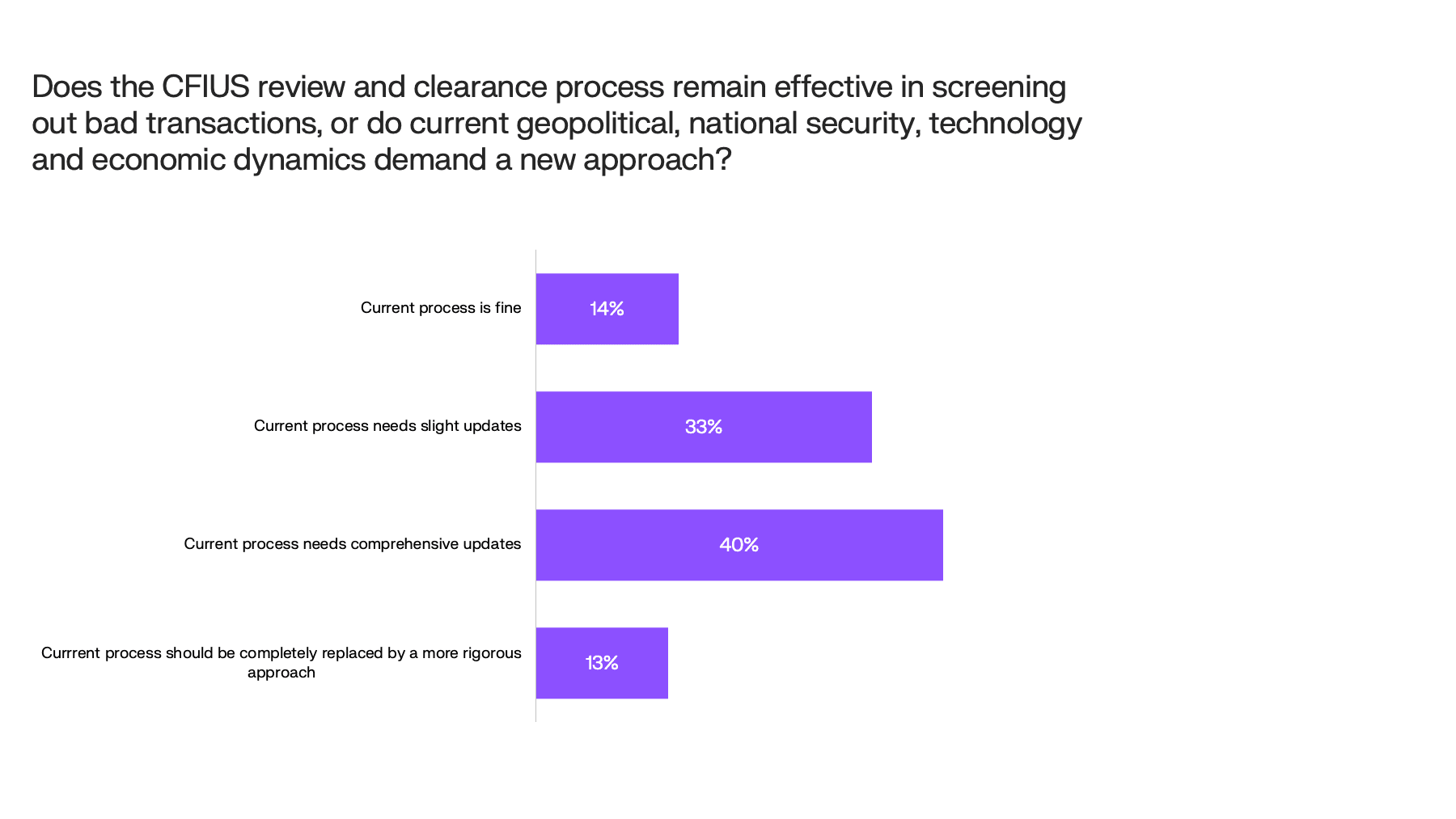
CFIUS process is increasingly viewed as vulnerable to external factors: In 2025, survey respondents increasingly viewed the US government’s transaction review process as subject to politicization or influence by competitors of one or more transaction parties. These perceptions, combined with growing concerns about the efficacy of long-term mitigation measures, have eroded confidence in the CFIUS process among political decision makers and opinion leaders in recent years. Significantly, 53% of this year’s survey respondents believe the current process needs comprehensive updates or needs to be replaced entirely.
US-focused recommendations: How to navigate the political-public landscape
Structure your deal carefully: Given the dynamic political and economic environment in the US, along with increased levels of scrutiny, dealmakers need to make sure their transactions are structured to minimize risk – for both US national security and the deal itself. Deals that need to be revised based on an early or late-stage request from CFIUS can find themselves in a defensive posture from which it can be difficult to recover.
Make no assumptions: Washington is playing by new rules, and so should dealmakers. Bring to bear all tools at your disposal, including personal contacts, since at times getting an entrée to a particular decision maker is just what is needed. Also remain attentive to government-to-government relations and other developments that might impact your deal, including opportunities to make its success part of a broader agreement.
Ensure your deal clearly advances US interests: In today’s environment, it’s generally not enough for a transaction to not raise red flags in order to be cleared. Success is much more likely to come to those who have clearly articulated the deal’s tangible value to the United States. Communicating these benefits early and often via disciplined messaging and targeted outreach can often make the difference between success and failure.
Political context
The November 2024 US elections, and subsequent transfer of power from President Joseph Biden to Donald Trump, set the stage for US policy changes on a scale few had fully anticipated. Familiar with the rhetoric President Trump had used to guide policy shifts in his first term, American political decision makers and opinion leaders – along with the public at large – were taken aback at the scope and pace of changes pursued within the first days and weeks of Trump’s second term.
Establishing new conditions for foreign investment in the US was among the Trump Administration’s top priorities at the beginning of 2025. Just one month after taking office, President Trump issued an Executive Memorandum entitled the “America First Investment Policy,” which did just that. Declaring that “economic security is national security,” this directive made clear that the new Administration “is committed to maintaining the strong, open investment environment that benefits our economy and our people, while enhancing our ability to protect the United States from new and evolving threats that can accompany foreign investment.” Among these threats, Trump singled out the People’s Republic of China (PRC) as the primary perpetrator, noting that “PRC-affiliated investors are targeting the crown jewels of United States technology, food supplies, farmland, minerals, natural resources, ports, and shipping terminals.”
To address these imperatives, President Trump’s memorandum instructed government agencies to establish regulations that will:
create an expedited “fast-track” process to facilitate greater investment from specified allies and partner sources,
expedite environmental reviews for any investment in the US of over $1 billion, and
restrict PRC-affiliated persons from investing in US technology, critical infrastructure, healthcare, agriculture, energy, raw materials and other strategic sectors.
Trump also announced plans in this memorandum to “strengthen CFIUS authority over ‘greenfield’ investments, talent and operations in sensitive technologies (especially artificial intelligence), and emerging and foundational technologies.”
Two high-profile transactions also served as indicators of the Trump Administration’s direction and congressional sentiment. As a candidate for the presidency in 2024, Donald Trump had criticized the possible sale of the iconic US Steel Corporation to Japan’s Nippon Steel, and called for any US government review to reject it. However, upon taking office, Trump stated a willingness to consider such a transaction, and worked through his first six months in office to secure terms for a sizable Nippon Steel investment in the company. The White House also negotiated a “golden share” for the government in US Steel, setting a possible precedent for a new type of mitigation action in the future.
President Trump’s handling of TikTok‘s presence in the United States also provided indications of how foreign investments would be handled in the months and possibly years to come. Trump had sought during his first Administration to ban TikTok from the United States, and congressional Republicans continued this effort during the Biden Administration. Claiming that Biden was weak on China, Republicans led efforts that were eventually joined by Democrats to enact legislation banning TikTok from US mobile devices, unless it was acquired by a US entity. Upon taking office, Trump suspended this directive based on his hope that a viable US buyer would emerge. He extended this temporary suspension multiple times during 2025 as various US companies sought to negotiate a deal, facilitated by the White House, to acquire TikTok from parent company ByteDance, along with its valued algorithm that personalizes the user experience. In the end, and despite some enduring bipartisan opposition, the White House announced that a consortium of US investors would take majority ownership of TikTok and control of its algorithm – demonstrating that despite evident national security concerns and a near unanimous vote by Congress, deals involving Chinese parties and large volumes of data will be possible during Trump’s second term in office.
More broadly, Trump has encouraged – even demanded – that foreign companies and governments make significant investments in the US to ensure favorable treatment by US policy makers and regulators. Many have promised to do so, but it remains to be seen how many will come to fruition and under what terms.
Detailed survey results
Our 2025 survey suggests that American policy elites strongly align with President Trump’s declaration in February that “economic security is national security.” More than 72% of respondents believe that economic policy should be guided by principles similar to those of national security policy. And even more think that FDI screenings should be more rigorous than they are today. Nearly 90% shared this sentiment, while fewer than 7% thought such screenings should be less onerous.


Our survey also reveals notable ties between the issues policy elites are most concerned about and the sectors they view as most in need of government controls. For example, the largest number of survey respondents – nearly 62% – want US investment screeners to ensure that transactions do not impede the supply of important products to the United States. When asked about the sectors they believe are most important to protect, nearly 67% of respondents identified health and biotechnology, and more than 60% cited energy and raw materials – sectors which contain products that have seen considerable debate over the past year. The value and availability of critical minerals for US manufacturers have received particular attention, in large part due to their use as bargaining chips in US-China trade and tariff negotiations. Similarly, the fact that US pharmaceutical companies depend on suppliers in India and China for the active ingredients in their products has prompted calls for increased domestic capacity to counter evident supply chain vulnerabilities.
Concerns regarding information and communication technology were also prevalent among policy elites and opinion leaders, with nearly 70% citing this as particularly sensitive. This may be attributable in part to the public debate over TikTok’s future ownership that, as noted above, dominated policy discussions over the past year.


Our survey shows that confidence in the current FDI review process, led by CFIUS, continues to wane. 75% of respondents believe that the CFIUS process has become somewhat or very politicized. Nearly the same percentage believe that competitors of those undertaking deals often seek to exert undue influence on the review process.


These developments prompted more than 53% of our respondents to call for significant changes to US screening processes and more than half to support the view that investors should not voluntarily subject themselves to government review.

Media discourse during a tumultuous period
Media coverage of foreign investment in 2025 focused largely on the transactional nature of new US policies. Tariffs dominated the news, as the Trump Administration imposed a dizzying array of duties on products from virtually every nation in the world. As lower rates were negotiated on a country-by-country basis, the relevance of foreign investments to US trade policy became evident – with promises of significant investments in the United States often replacing the high tariffs that Trump had threatened.
Some investments have taken the form of sovereign promises of greenfield projects in the US, while others have involved major corporations committing to build more infrastructure and create new jobs. In reporting on the October summit meeting between President Trump and Chinese President Xi Jinping, it was even suggested that Trump responded positively to the prospect of more Chinese investments in the United States. This appetite contrasts sharply, however, with US government threats to strengthen export controls and delist Chinese companies from US stock exchanges. Some of these proposed controls appeared in legislation only, but their mention in Trump’s own “America First Investment Policy” suggests that more of this may come from the White House as well.