The politics of cross-border deals today
Spotlight on Germany

How do political stakeholders view foreign investments in Germany? Which sectors and countries of origin attract the greatest scrutiny? Which aspects spark concern and what factors can make or break a deal? Building on our 2024 edition, we have taken another pulse check to illuminate the German public-political landscape shaping the fate of cross-border transactions.
Executive summary
The high-scrutiny FDI climate persists. 84% of German respondents still call for more stringent screening, marking only a marginal drop from 85% last year.
Chinese investors remain under the closest scrutiny, with stable attention on Middle East investors and a sharp increase desired in scrutiny of U.S. investors. Geopolitical considerations continue to play a key role, with a decisive majority supporting economic policy being guided more closely by security policy principles. Growing calls for closer reviews of US investment likely mirror growing friction in transatlantic economic relations.
Critical deal factors extend beyond formal screening criteria. Respondents again prioritize job retention, security of supply and technology transfer risks — broadly consistent with last year’s findings, when supply security and employment effects also topped the list. This continued focus reflects ongoing debates about Germany’s economic competitiveness, with concerns about industrial decline and economic sovereignty contributing to heightened political sensitivity around cross-border transactions.
Support for tighter controls for critical sectors, but lighter procedures for non-sensitive cases. A majority favors a new German FDI screening legislation with stricter provisions, including additional sector-specific screening categories and explicit consideration of economic resilience and autonomy in review criteria. However, stakeholders simultaneously call for reducing procedural burdens and accelerating review times for less sensitive cases. We expect that new legislation – the timing of which remains to be seen – will reflect this by taking a simplifying approach.
German media coverage on FDI has shifted to a more sustained thematic debate. While coverage still peaks around high-profile transactions, the past 12 months have seen media link FDI more consistently to broader debates about Germany’s economic competitiveness and security.
Germany-specific recommendations: How to navigate the political-public landscape
Align deal structures with political priorities, including job retention and security of supply, that relate to economic competitiveness and sovereignty. Individual transactions can be easily assessed in the context of broader policy objectives. Dealmakers should structure transactions in a way that seeks to address substantive stakeholder concerns, using early and credible commitments to build trust and pre-empt objections.
Frame deal communications around strategic value, not just commercial logic. Our analysis shows that – whether explicitly stated by authorities or not – the factors considered in review procedures are steadily expanding beyond strict definitions of “national security” into economic security. Commercial rationales alone will not carry a transaction. Dealmakers should frame investment in terms of how it strengthens Germany’s long-term competitiveness, reduces dependencies and/or safeguards critical capabilities.
Prepare for shifts and be ready to adjust your engagement strategy. Comparison with last year’s findings shows how sensitivities around sectors and investor origins can shift quickly. A clear, scenario-based engagement plan helps you remain in control and maintain credibility when political headwinds emerge.
Political context: Growth and security top the new government’s agenda, putting FDI screening in a central position
Germany’s government, formed in May 2025, has set out to deliver on two ambitions: bringing Germany back onto a growth path after years of economic stagnation, and dramatically increasing the country’s security. Foreign investment sits at the intersection of these guiding priorities. The government is intent on sending signals that Germany is open to and attractive for foreign business. The Chancellor appointed Martin Blessing as dedicated Chief Investment Officer to promote Germany abroad and is reportedly planning a “Choose France”-style conference to attract foreign investment.
Amid heightened awareness of Germany’s changed security environment, however, this renewed focus on foreign investment is not without limits. The government remains keen to reduce dependencies on China, and Parliament established a new commission in November to systematically analyze these dependencies. In its coalition treaty, the government agreed to revise the Foreign Trade and Payments Act to “effectively prevent foreign investments that contradict our national interests in critical infrastructure and strategically relevant areas.” Note the catch-all phrase “not in our national interests,” which seems to broaden political discretion in reviewing foreign acquisitions. However, the government has so far failed to make progress on a promised overarching economic security strategy that would underpin the new FDI screening law and other economic security tools.
For foreign investors looking to make acquisitions in Germany, there is room to connect with the new government and perhaps a new openness to engage on business- and growth-centered arguments. But investors still need to navigate political interests, national security priorities and often face complex procedures involving a variety of stakeholder interests that need addressing.
New insecurities around the changing nature and trajectory of the transatlantic relationship create unique challenges for U.S. investors, with previously low-risk transactions now attracting government and public scrutiny.
High FDI scrutiny shows no signs of easing, and job retention and security of supply remain main issues of concern
Our survey results show that the high-scrutiny climate surrounding FDI persists. When asked whether foreign investment should be screened more or less stringently, 84% of German respondents favored stricter measures. These figures are virtually unchanged from 2024 (when 85% favored stricter controls), confirming that support is not a temporary reaction to individual geopolitical shocks but a consistent trend shaping Germany’s economic policy landscape.

Accordingly, a strong majority of 77% thinks security policy principles should guide economic policy more than in the past. For investors, this new climate brings fundamental implications: transactions are now politically evaluated not only for their immediate economic benefits but also for their expected impact on Germany’s longer-term competitiveness, resilience and sovereignty. Deal narratives that emphasize how the transaction will strengthen competitiveness, resilience and sovereignty will therefore resonate more effectively than purely commercial arguments.
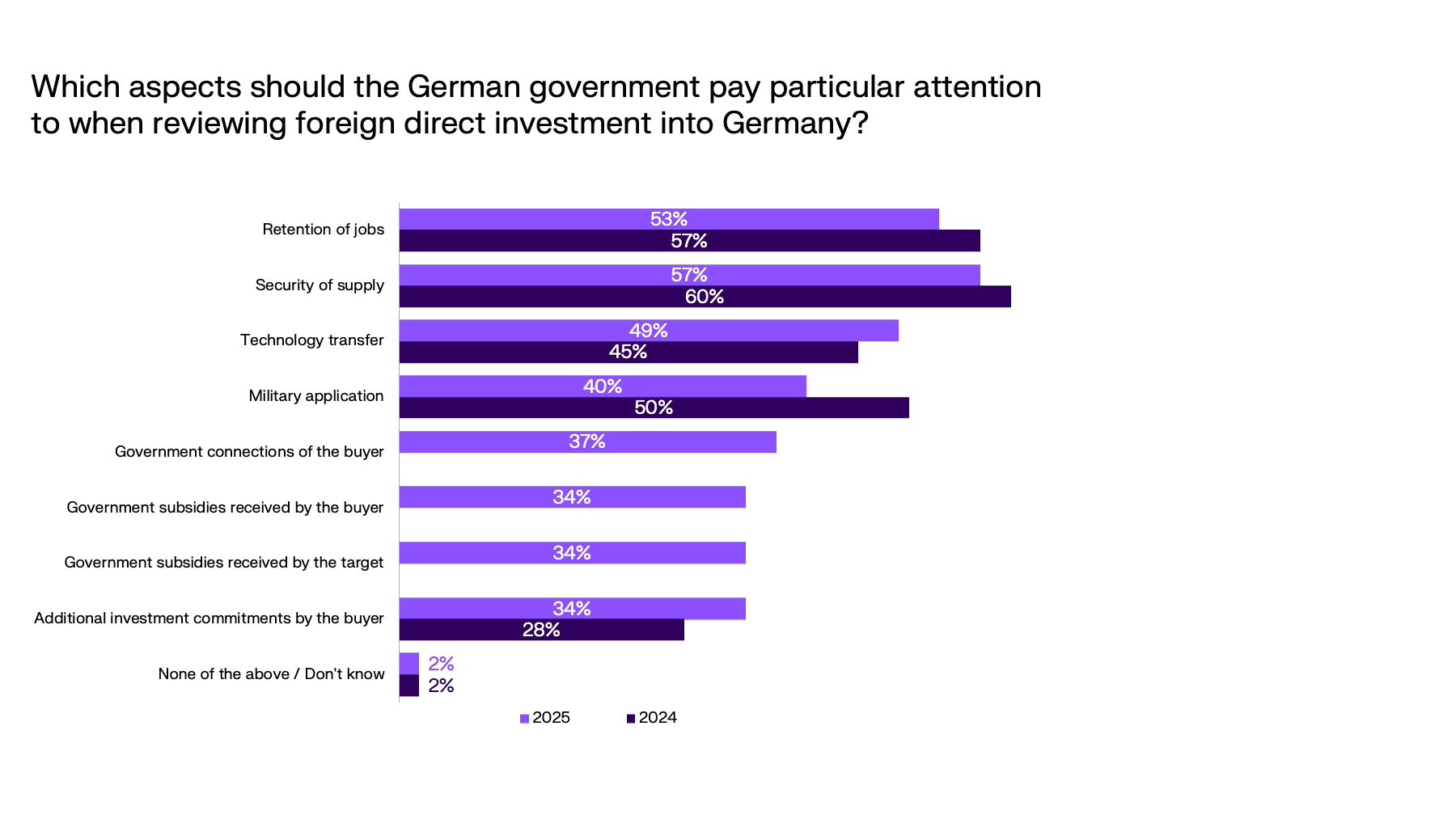
Political decision-makers continue to focus on domestic, tangible effects of foreign investments. When asked which aspects should be paid particular attention to when reviewing inbound FDI, respondents identified three top issues: retention of jobs (53%), security of supply (52%) and technology transfer (49%). These priorities show remarkable stability compared to 2024. The slight decline in emphasis on security of supply may reflect some normalization following the acute supply chain crises of recent years, though it remains a critical consideration. Military application and government connections of the buyer form a second tier of concern, followed by the role of government subsidies and the strategic value of the target company.
What does this mean for dealmakers? Parties to a transaction can overcome concerns by implementing credible job guarantees, securing buy-in from works councils and unions and emphasizing positive impacts on local employment reflected in binding agreements. Similarly, if investment plans can contribute to security of supply, investors should accentuate this in transaction structures and communications, for instance by safeguarding capacities in Germany or issuing guarantees to maintain certain business relationships.
FDI into defense, ICT and energy still considered most sensitive; China remains under most intense scrutiny and calls for closer reviews of U.S. investors are growing
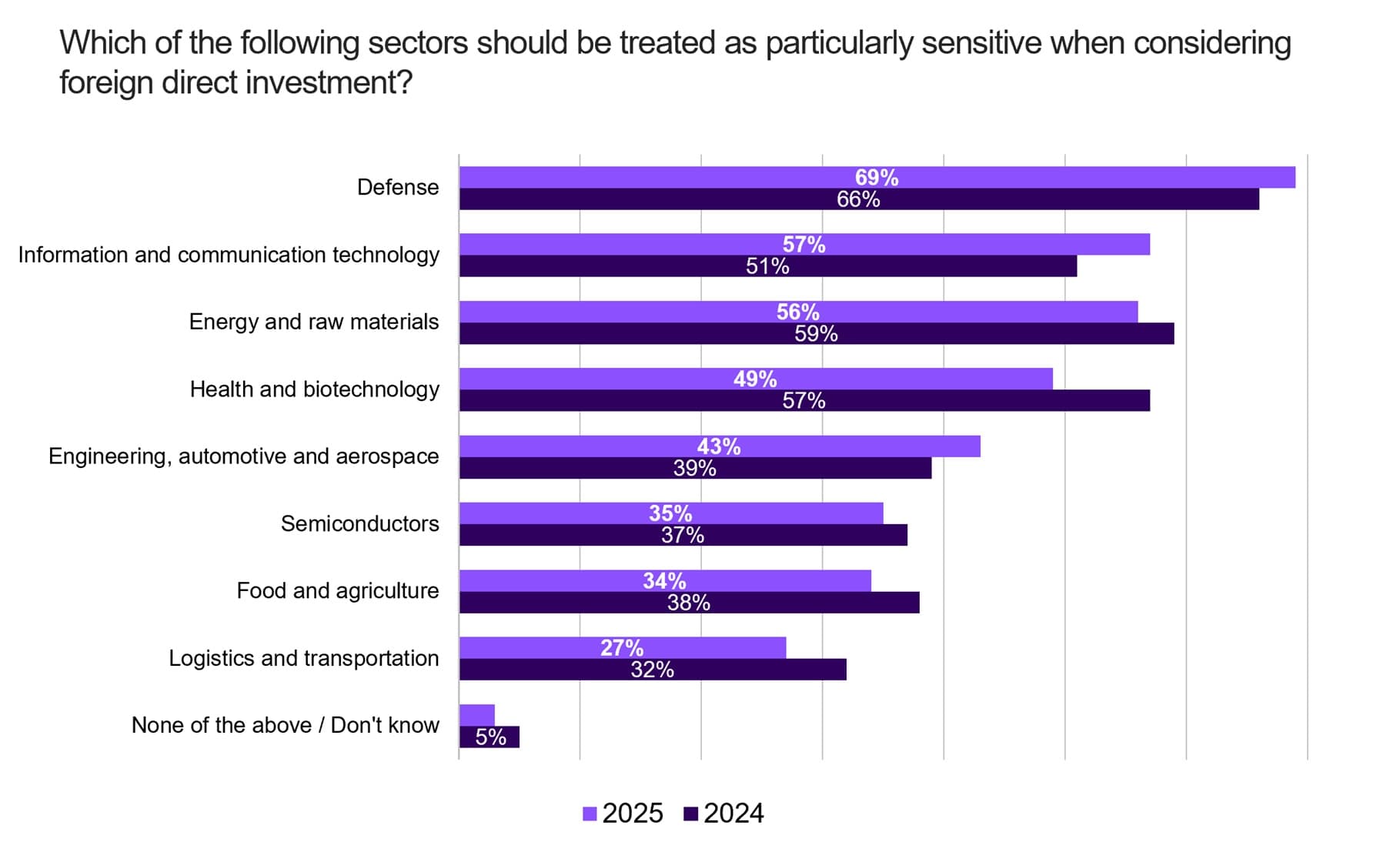
Defense tops the list again, with 69% of respondents saying FDI into defense should be treated as particularly sensitive – consistent with last year (66%) and reflecting both regulatory reality and political consensus about protecting military-relevant capabilities. Attention to information and communication technology (ICT) has risen sharply from 51% to 57%, overtaking energy and raw materials as the second-most sensitive sector. This shift reflects growing awareness of cybersecurity risks and the strategic importance of telecommunications and data infrastructure. Recurrent cybersecurity incidents and ongoing 5G security debates have elevated ICT infrastructure in political consciousness, reinforcing awareness of its strategic importance. Energy and raw materials (56%) remain regarded as highly sensitive. While acute energy supply disruptions have moderated, concerns about dependencies on foreign energy sources and critical mineral inputs persist.
China remains the country of origin that respondents are most concerned about (78%, nearly unchanged from 79% in 2024). This reflects political priorities and long-standing concerns about technology transfer, state influence and strategic competition. Middle East investors also face high, though slightly reduced, scrutiny, at the same time as political and economic ties grow closer.

Perhaps the most striking shift in 2025 is the deteriorating confidence toward U.S. investors: 47% of respondents believe U.S. investments should be reviewed more closely – up from 35% in 2024. In a more confrontational transatlantic climate, U.S. investors can no longer assume smooth sailing in screening procedures but must prepare for heightened scrutiny and more complicated reviews.
Stricter controls for sensitive but streamlined processes for routine cases desired
Stakeholders hold contradictory expectations regarding a dedicated German investment screening law, which is still planned but will likely have a different focus under the new government. When asked whether a new law should focus on simplification or stricter controls, 57% lean toward stricter controls, while 26% prefer simplification. The top reform priority is defining additional sensitive sectors (52%). The second priority is incorporating economic resilience and autonomy into formal review criteria (45%). Notably, stakeholders also support reducing procedural burdens (37%) and shortening review times (27%) for non-sensitive transactions. This reflects the political ambition to balance two conflicting policy goals: ensuring national security while signaling continued openness to foreign investors.
German FDI media discourse has shifted towards a more sustained debate
Media coverage of foreign investment by leading German outlets has become more sustained and thematic over the past year, shifting from episodic reporting on individual transactions to a broader debate linking FDI to Germany’s economic direction and security.

Three main themes have shaped German media reporting about FDI in the past 12 months. First, media coverage connects foreign investment more closely with Germany’s broader economic and security trajectory. Reporting intensified around the federal elections and government formation, highlighting stricter “national security” considerations cited by the coalition agreement as well as reactions to more interventionist U.S. trade and industrial policy. A second recurring theme is Germany’s diminishing appeal as an investment destination. Coverage repeatedly highlights concerns about economic competitiveness, with media using FDI inflows as indicators of Germany’s overall economic direction. Third, while reporting has become more continuous, high-profile transactions remain focal points for debate. Transactions involving German target companies such as the Covestro acquisition and APG’s and GIC’s investments into TenneT continue to generate substantial coverage and serve as catalysts for broader debates.
This presents both opportunities and risks for deal framing. While highlighting economic benefits and credible commitments can generally help shape positive narratives, understanding sensitivities and calibrating messaging in line with evolving political priorities remain essential to building support and getting the deal done.