The politics of cross-border deals today
Spotlight on Japan

Executive summary
Japan’s approach to inbound foreign direct investment (FDI) is entering a new era, sharply defined by the intersection of economic security and global competitiveness, a trajectory that will come as no surprise to observers of government relations who have long tracked Japan’s regulatory and geopolitical evolution.
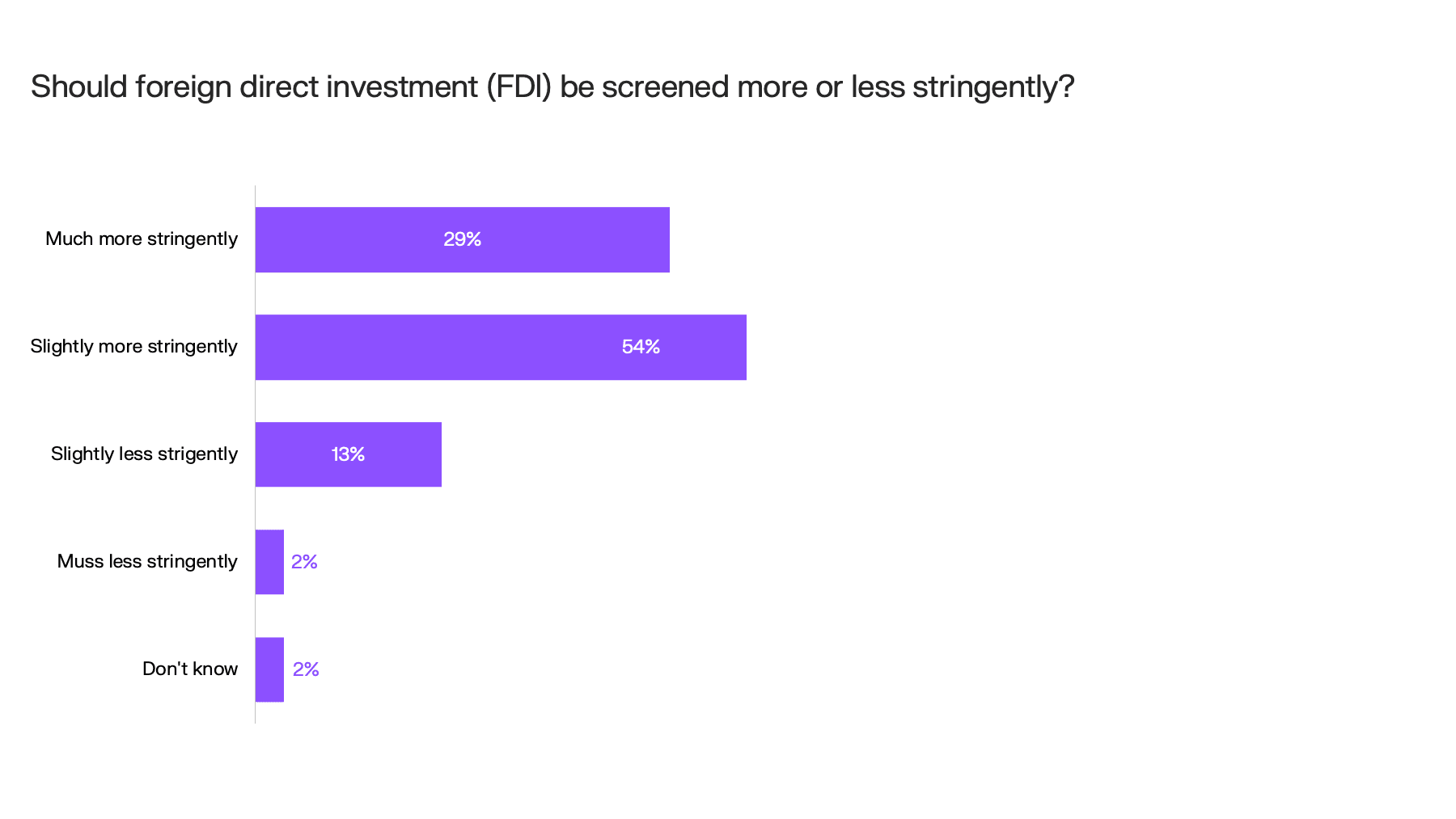
As Prime Minister Takaichi’s administration accelerates reforms – most notably to the Economic Security Promotion Bill and the Foreign Exchange and Foreign Trade Act (FEFTA) – the voices of Japan’s policy stakeholders are resounding with clarity and urgency. Our 2025 survey of Japanese policy and political opinion leaders reveals overwhelming support for a more robust, security-driven investment screening regime: over 85% want economic policy to align with national security, and more than 80% favor stricter FDI screening, particularly for sectors tied to defense, advanced technology and critical infrastructure.
At the same time, Japan remains committed to attracting high-quality foreign investment that supports innovation and growth. This dual mandate – protection with openness – will define the Japanese deal landscape in 2025 and beyond. This report explores how regulatory reforms, geopolitical dynamics and stakeholder sentiment are converging to reshape deal clearance in Japan, providing practical insights for investors and dealmakers navigating this evolving environment.
Political context: A government anchored in economic security
Prime Minister Takaichi’s administration has placed economic security at the core of national policy. Her track record – ranging from championing Japan’s first Economic Security Promotion Act to advocating for tighter controls on foreign access to advanced technologies – signals a durable political mandate to reinforce Japan’s FDI screening framework.
The government’s objective is not broad protectionism. Instead, Japan is shifting toward a more targeted and risk-based approach: narrowing requirements for low-risk sectors while reinforcing scrutiny for investments touching national security, dual-use technologies and critical supply chains.
Particularly noteworthy is that Japan is preparing its next round of revisions of relevant laws and regulations. Key anticipated changes in 2026 potentially include:
Sharper targeting: Relaxing pre-filing requirements for low-risk IT and service businesses, while tightening obligations for defense, cybersecurity, advanced electronics and semiconductor supply chain assets.
Closing loopholes: Addressing indirect or layered acquisitions that obscure the ultimate investor, particularly where foreign-government involvement is possible.
Strengthening interagency coordination: Exploring a more centralized screening mechanism to unify intelligence inputs and improve predictability.
Looking ahead
As Japan refines its regulatory guardrails through 2026 and beyond, the emerging trajectory points toward strategic selectivity rather than retrenchment. Policymakers remain mindful that inbound investment is vital for innovation, competitiveness and productivity growth. The regulatory direction appears to favor targeted caution over diminished openness.
Survey highlights
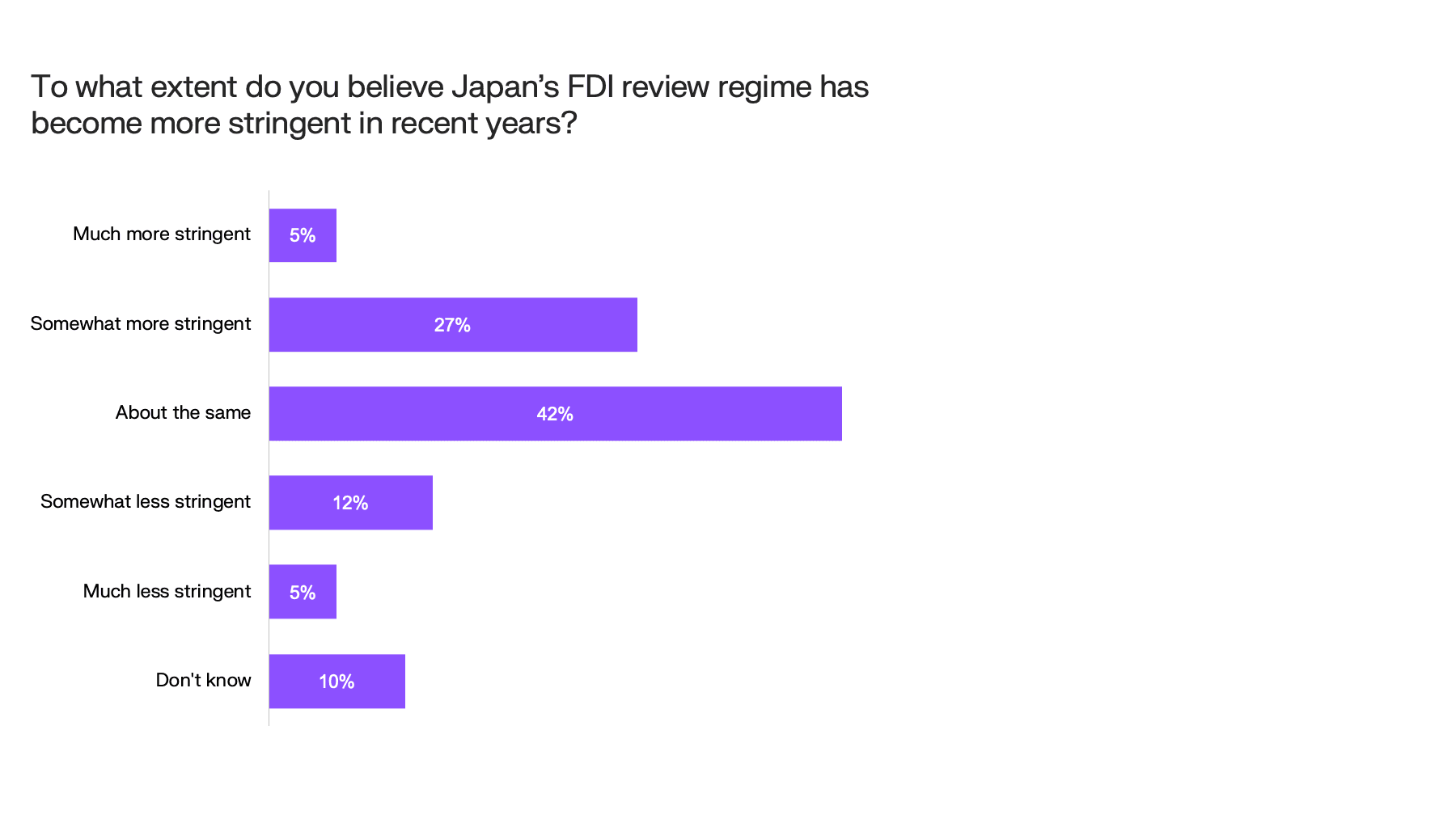
Clear appetite for stricter FDI screening: Over four out of five respondents (84%) believe Japan should screen foreign investments more stringently. Yet only 32% believe the regime has actually become more stringent in practice (27% “somewhat more stringent” + 5% “much more stringent”), while 42% see it as unchanged and 16% perceive it as less stringent. This 51-percentage-point gap between desired stringency and perceived implementation indicates broad support for reforms that make screening both more predictable and more robust.
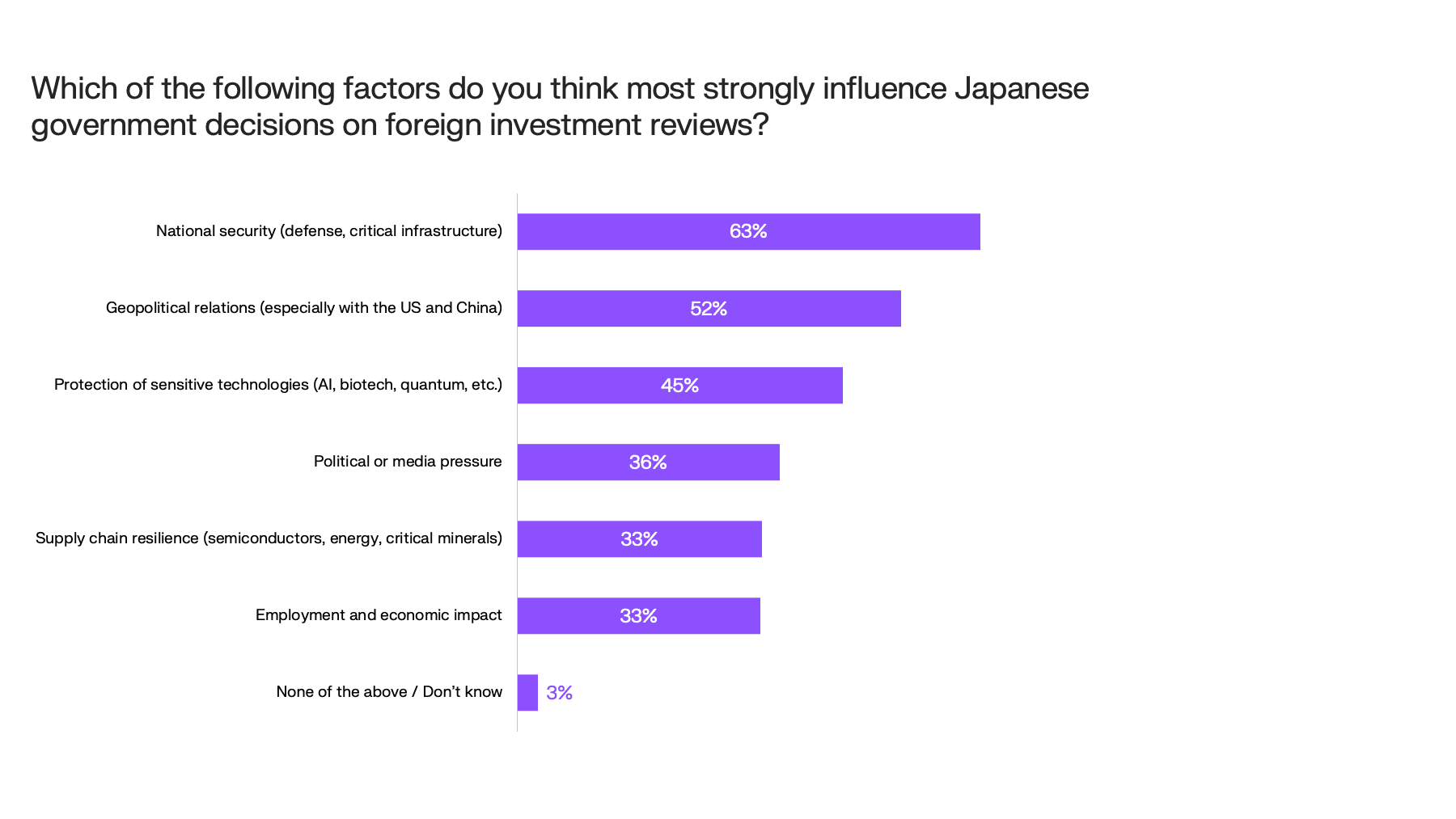
National security and geopolitical impact: Respondents overwhelmingly identify national security considerations as the dominant factor shaping Japan’s FDI decisions. 63% cite national security (defense/critical infrastructure protection) as the most influential factor, followed by geopolitical relations, particularly around U.S.-China dynamics (52%), and technology protection in AI, biotech and quantum computing (45%). When evaluating specific deal characteristics, military applications (49%) and technology transfer risks (51%) rank as the top two screening priorities, underscoring the centrality of security and strategic technology concerns.
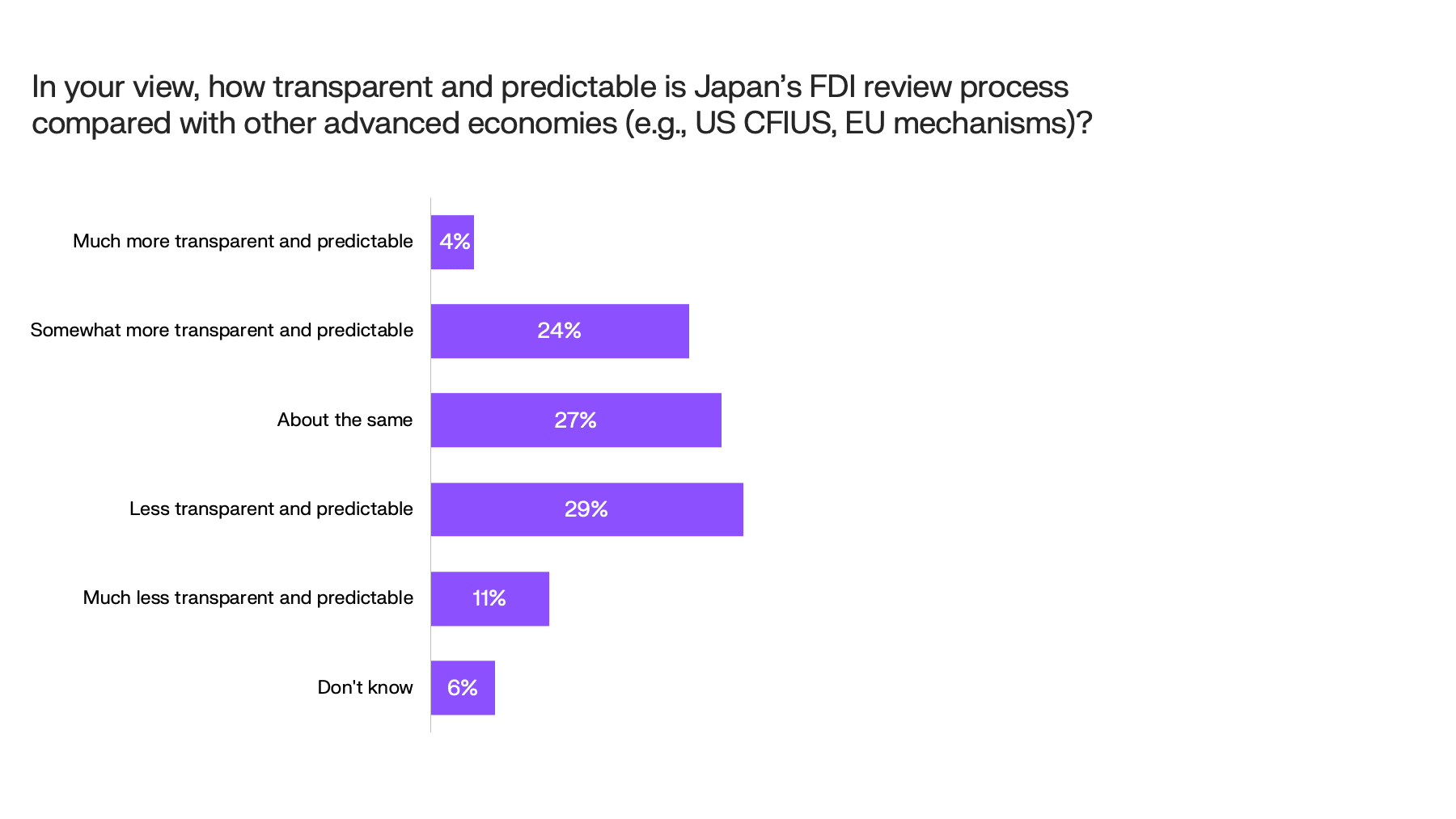
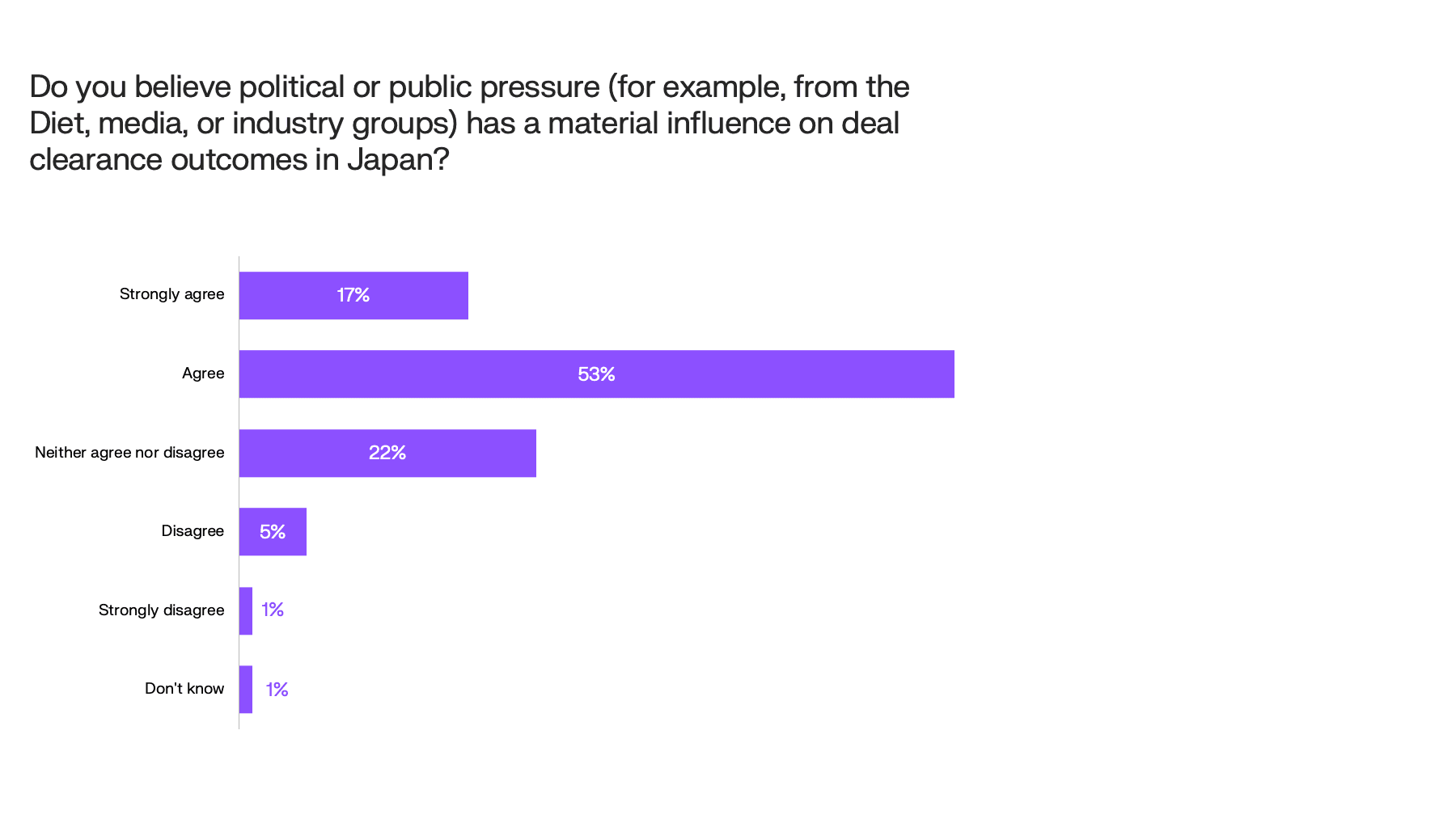
Gaps remain with transparency and predictability: Over two-fifths of respondents (40%) view Japan’s review process as less transparent than U.S. CFIUS or EU mechanisms (29% “less transparent” + 11% “much less transparent”), while only 27% rate it as more transparent and 27% see it as comparable. Additionally, 70% acknowledge that political and public pressure materially influences deal outcomes (53% “agree” + 17% “strongly agree”), suggesting concerns about consistency and predictability. These perceptions reinforce the political case for a more unified, cross-government structure with clearer processes and timelines.
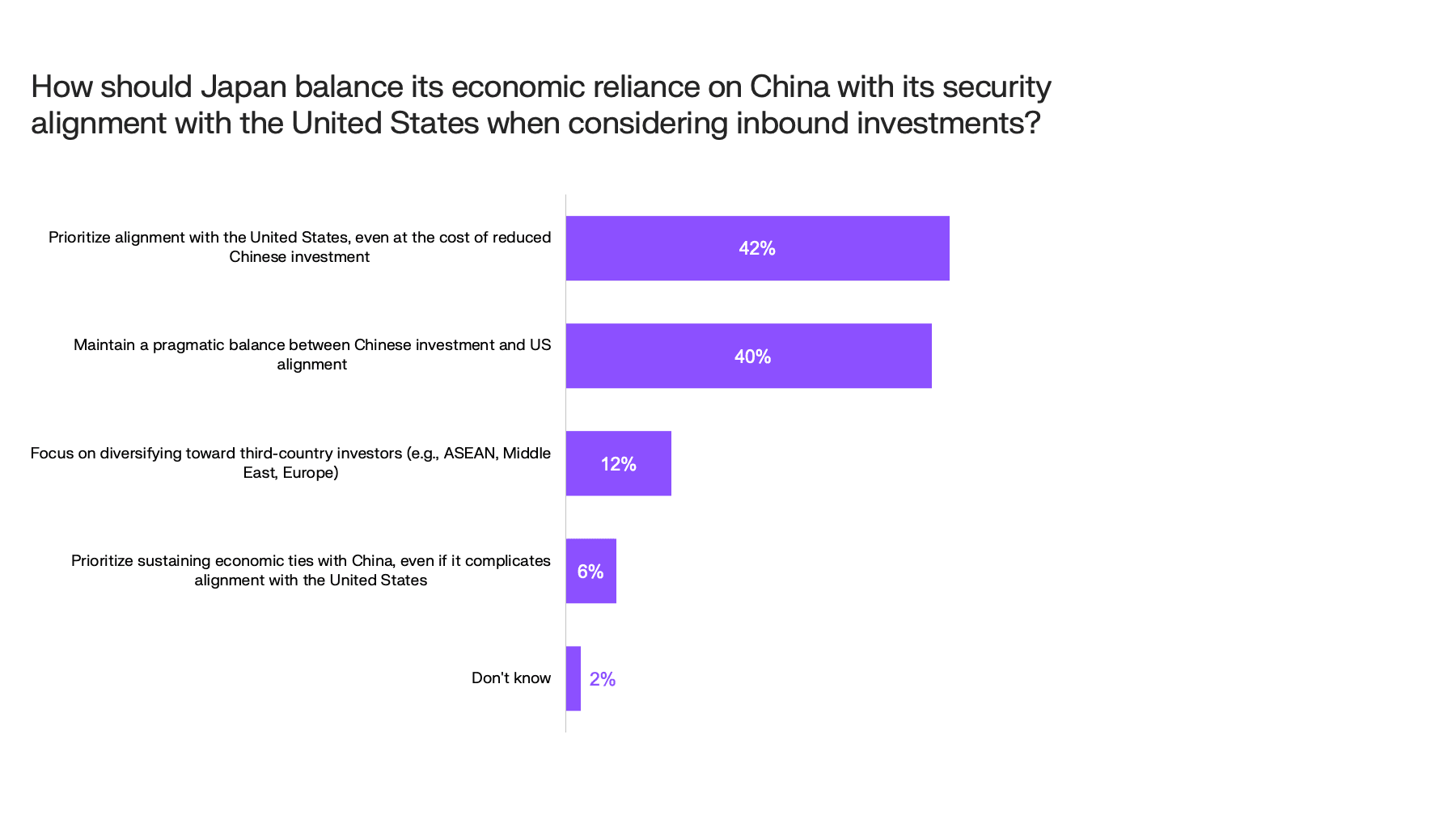
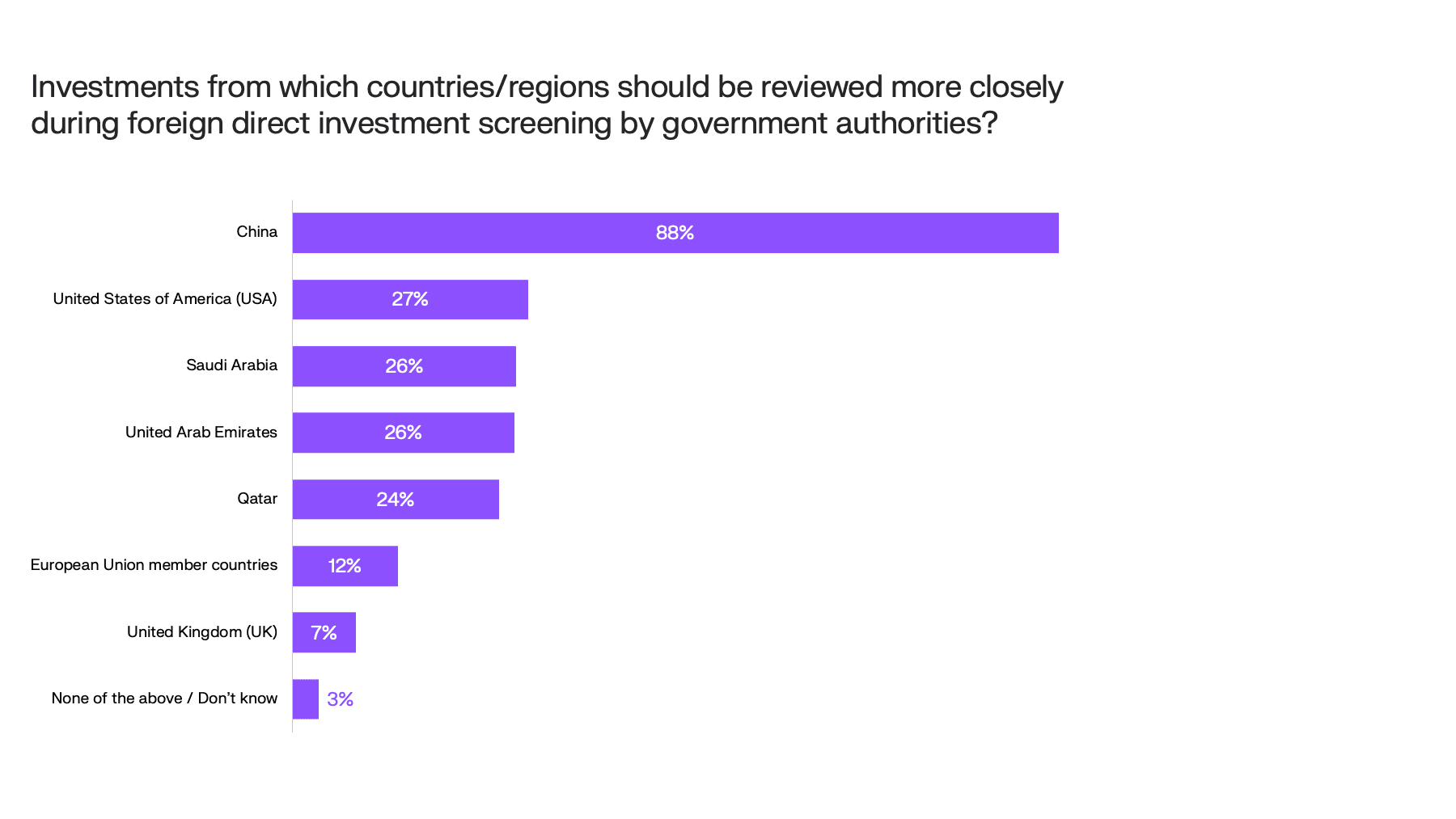
Strong alignment with U.S. security priorities: When forced to balance competing priorities, 42% of respondents favor prioritizing security alignment with the United States, even at the cost of reduced Chinese investment; this was the single largest response. An additional 40% support a pragmatic balance between both powers, while only 6% favor maintaining strong China ties even if it complicates U.S. alignment. Meanwhile, 88% flag Chinese investment as requiring closer review, by far the highest concern of any country (U.S. at 27% is a distant second). This data demonstrates overwhelming support for a U.S.-oriented security posture over a China-centric economic approach.
Broad support for expanding sensitive sectors: 81% support expanding the list of sensitive sectors subject to enhanced screening (36% “definitely” + 45% “somewhat”), with only 11% believing current coverage is sufficient. Priority sectors identified include defense (74%), ICT/telecommunications (62%), energy and critical minerals (59%), semiconductors (58%) and health/biotechnology (53%). Technology protection, encompassing AI, biotech and quantum technologies (45%), ranks as the third-most influential factor in government decision-making, reflecting strong appetite for expanded oversight of advanced and dual-use technologies across semiconductors, telecommunications, energy systems and emerging tech domains.
Implications for dealmakers
Prepare for higher scrutiny in strategic sectors: Transactions involving defense, dual-use technology, semiconductors, aerospace, energy infrastructure, cloud or data assets and advanced electronics should anticipate deeper diligence, earlier regulatory engagement and potentially longer timelines.
Investor identity will be more closely examined: Japan’s 2025 classification rules for investors linked to foreign governments (Type-A / Type-B) mean that provenance, control structures and beneficial ownership will face greater scrutiny, regardless of deal size. Reflecting this, 49% of respondents believe that government connections of the buyer should be a primary focus in FDI review, further justifying heightened regulatory attention to investor identity and control structures.
Strategic narrative matters: Addressing concerns around technology transfer (51%), security of supply (42%) and the strategic or heritage value of the target company (46%) will be crucial for deal approval. Investors who clearly demonstrate how their transaction contributes to Japan’s economic security, such as by committing to technology retention, local R&D, supply-chain resilience or alignment with allied security interests, will be better positioned to secure clearance, as these factors are identified by survey respondents as top priorities for FDI review.
Political and media exposure cannot be ignored: Over 70% of respondents believe political and public pressure influence FDI review outcomes. Specifically, 70% agree or strongly agree that political or public pressure materially influences deal outcomes, with only 6% disagreeing. This places a premium on stakeholder engagement, issue-management planning and disciplined communications around high-profile deals.
Opportunities for aligned investors remain strong: Despite heightened scrutiny, Japan’s M&A market continues to expand, supported by structural reforms, corporate divestitures and strong foreign investor interest. Investors that engage constructively with the emerging security framework will find ample opportunity.
Media narrative
Japanese media increasingly contextualize inbound M&A within the broader arc of economic security and geopolitical tension. Coverage frequently highlights risks around technology leakage, critical infrastructure and national resilience, particularly in relation to China. At the same time, business outlets underline Japan’s record dealmaking volumes, attractive valuations and the government’s need for foreign capital to drive innovation and accelerate restructuring.
The prevailing narrative is not anti-FDI, but conditions-based openness; investment is welcomed when it strengthens Japan’s long-term capabilities and scrutinized when it poses strategic risks. This dual framing is now integral to how foreign acquisitions are assessed in the public sphere, and thus part of the environment dealmakers must navigate.
Conclusion
As Japan refines its FDI screening mechanisms, the direction is clear: economic security is now a central pillar of investment policy, and stakeholder expectations are driving a more selective, risk-calibrated approach. The survey results underscore a decisive shift – toward deeper scrutiny of foreign investors, especially those linked to strategic sectors or geopolitical rivals, and toward greater transparency and predictability in the review process.
Yet, the message from policymakers and the market is not one of retrenchment. Japan’s openness to foreign capital remains strong, especially for investors who can demonstrate alignment with national priorities such as technology retention, supply chain resilience and contributions to economic security. For dealmakers, success will increasingly depend on proactive engagement, strategic narrative development and a clear understanding of both the regulatory landscape and the priorities of Japanese stakeholders.
In this evolving context, those who adapt to Japan’s new paradigm – combining rigorous diligence with stakeholder alignment – will be best positioned to unlock opportunity and drive value in this dynamic market.