DEAL CLEARANCE


Navigating Politics and Capturing Opportunity in Cross-Border M&A

For a growing number of deals, the decisive approval no longer comes only from shareholders or boards: political judgment and public perception increasingly shape whether, on what terms and how quickly cross-border transactions close.

Drawing on our annual survey of key markets, the 2026 FGS Global Deal Clearance Report shows where foreign investment scrutiny is heading, which issues, sectors and investor origins draw the closest attention, and how geopolitical considerations shape review processes and outcomes.

Assessing both global and market-specific trends, our report provides dealmakers with practical insights and guidance for structuring and communicating transactions – particularly when cross-border – in ways that mitigate risk and capture opportunities that a shifting global investment environment creates.


Our 2026 key findings

  • Conditional openness to foreign investment is the prevailing view: Between 77% and 90% of respondents in every market are open to foreign investment, but most of them only with appropriate safeguards.

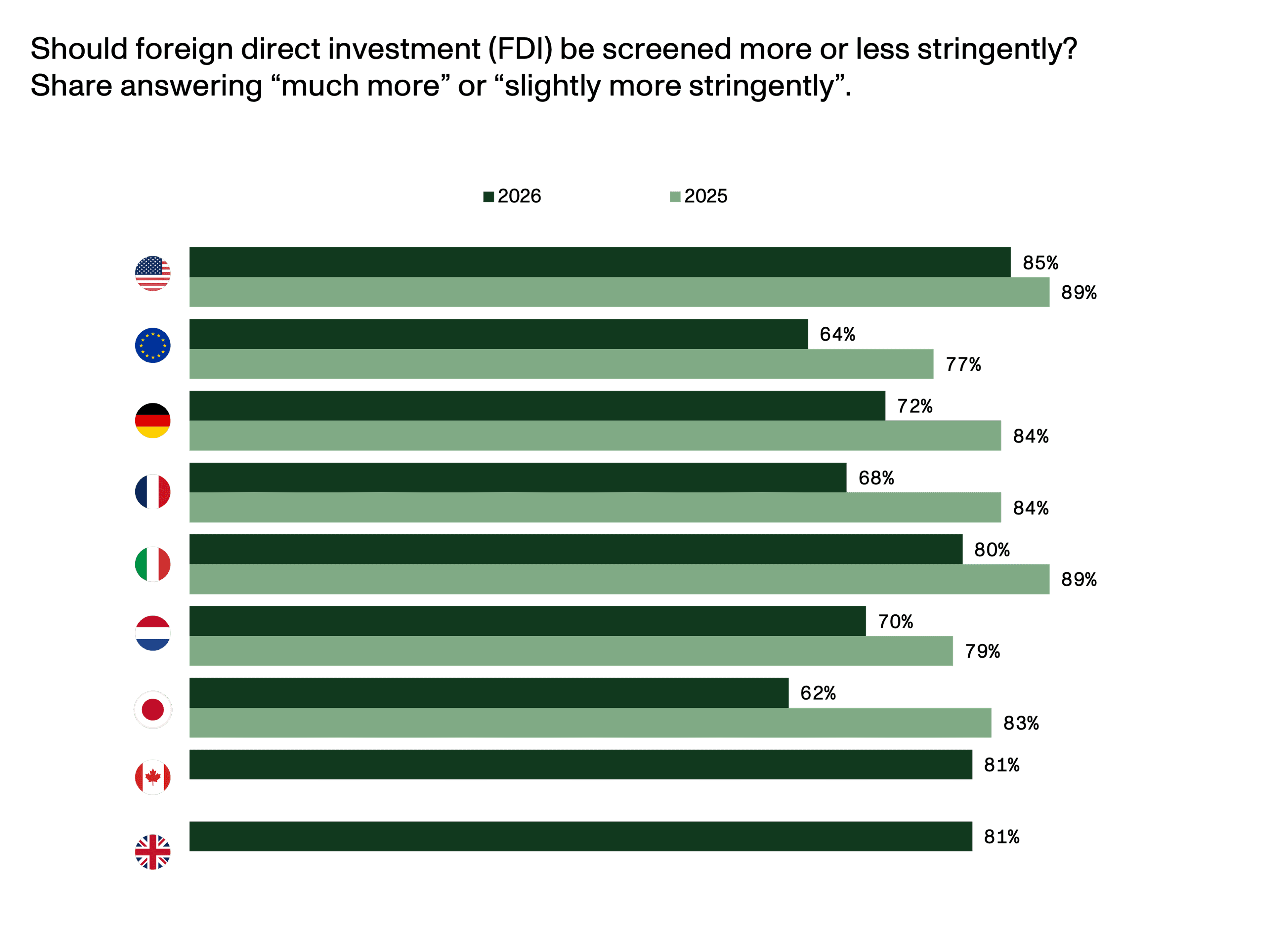
  • Support for stricter screening remains high: While levels of support have declined, clear majorities want FDI to be screened more stringently, ranging from 62% in Japan to 85% in the U.S.

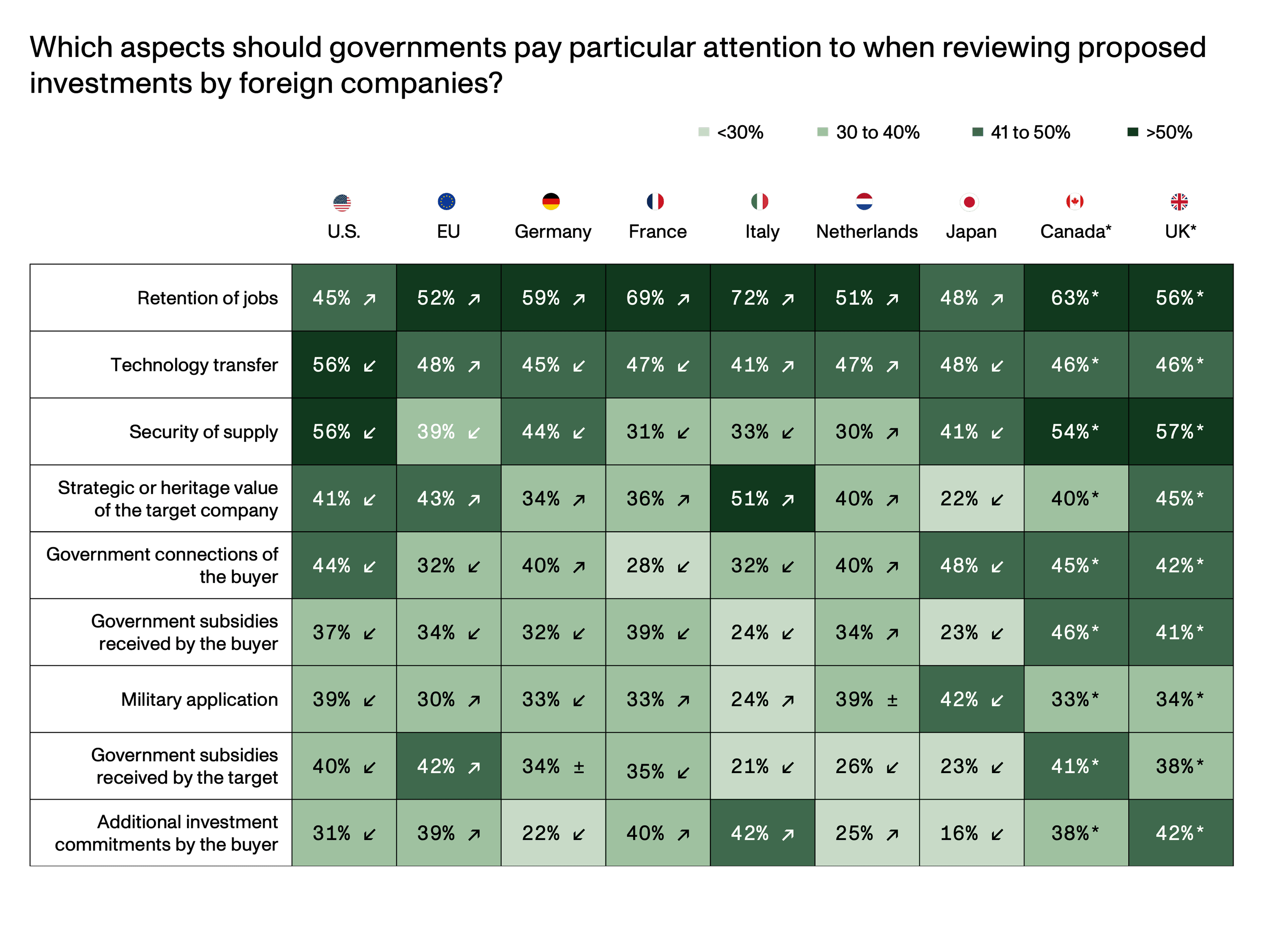
  • Job retention and technology transfer are key criteria: On average, 57% of respondents want authorities to pay particular attention to job retention (2025: 46%), ahead of technology transfer and security of supply. Job retention has gained ground in all seven markets surveyed in 2026 and 2025.

  • China remains the main concern, but scrutiny of U.S. investments rises sharply in many markets: Chinese investments face the most scrutiny across markets by a wide margin. Calls for stricter reviews of U.S. investments are rising, with majorities in five markets and ranging from 44% to 65% outside Japan (2025: 36% to 51%).

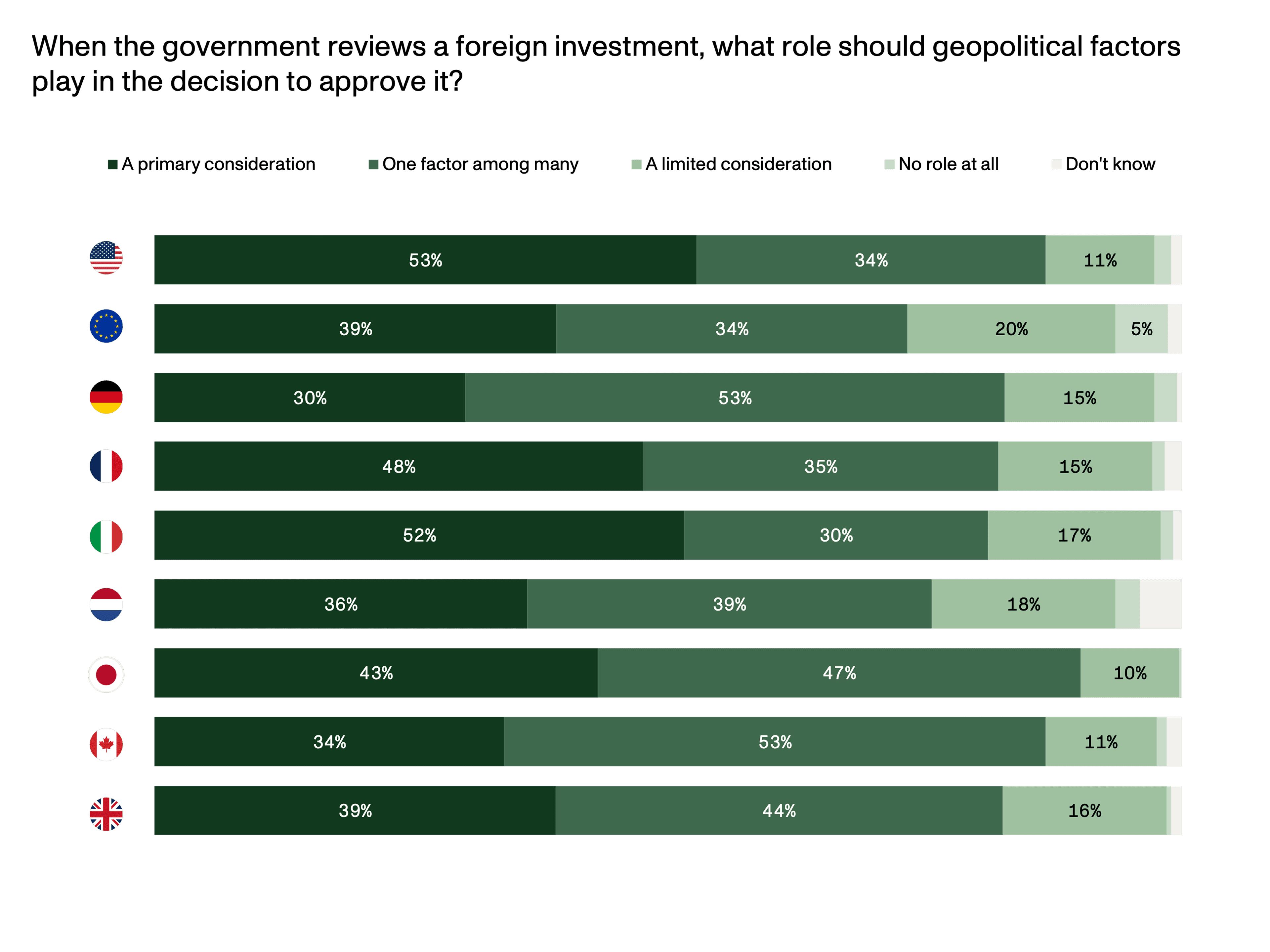
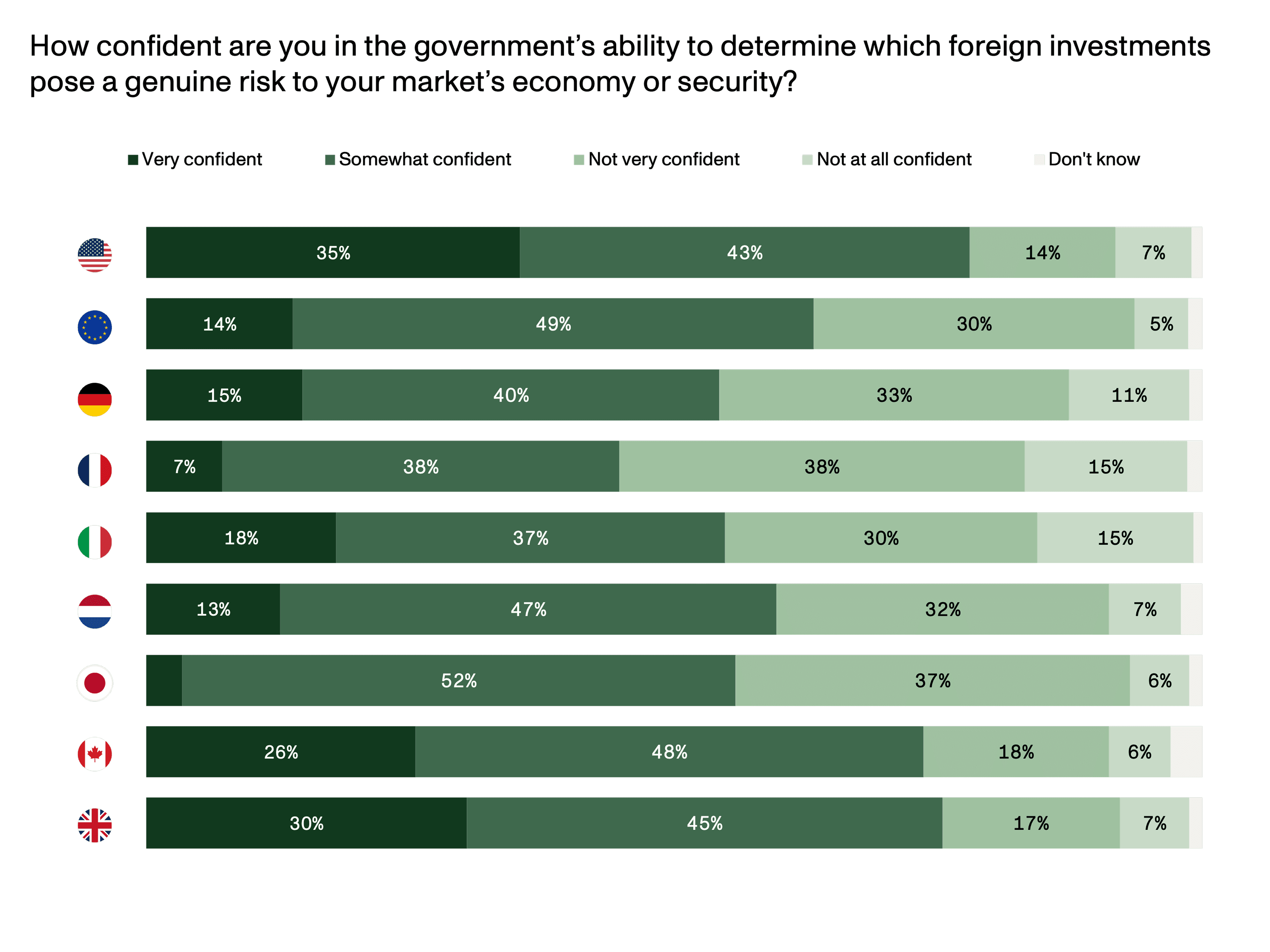
  • Geopolitical developments are expected to inform reviews, while confidence in government judgment varies: At least 73% of respondents in every market want geopolitical factors to be considered. Confidence in government’s ability to adequately assess risks stemming from FDI ranges from 78% in the U.S. to 45% in France.
Download the report

The full report – including further comparative findings, our recommendations for dealmakers and deep dives into the political-regulatory environment shaping foreign investment in nine markets – is available here.


Stricter FDI screening demanded across markets

The findings suggest that existing safeguards are not considered sufficient in and of themselves to address perceived economic and/or security risks stemming from foreign investment. For dealmakers, this means preparing less for immediately stricter rules than for the risk of politicized processes. As geopolitical tensions grow and economic security moves into the mainstream political debate, so does the circle of stakeholders who seek to influence reviews, bringing traditionally legal and technical procedures onto the political agenda.

The findings suggest that existing safeguards are not considered sufficient in and of themselves to address perceived economic and/or security risks stemming from foreign investment. For dealmakers, this means preparing less for immediately stricter rules than for the risk of politicized processes. As geopolitical tensions grow and economic security moves into the mainstream political debate, so does the circle of stakeholders who seek to influence reviews, bringing traditionally legal and technical procedures onto the political agenda.

Job retention and technology transfer rank among top areas of concern across markets

Although job retention is rarely a formal screening criterion, it increasingly shapes the political climate in which authorities decide. Dealmakers who identify such triggers of political salience early and address them proactively in deal and communications design, for example through credible commitments on employment, investment or supply, can turn potential objections into arguments for approval. Since these triggers evolve with the geopolitical and domestic context, dealmakers must take care to stay attuned to what matters for the moment when their transaction comes together.

Although job retention is rarely a formal screening criterion, it increasingly shapes the political climate in which authorities decide. Dealmakers who identify such triggers of political salience early and address them proactively in deal and communications design, for example through credible commitments on employment, investment or supply, can turn potential objections into arguments for approval. Since these triggers evolve with the geopolitical and domestic context, dealmakers must take care to stay attuned to what matters for the moment when their transaction comes together.

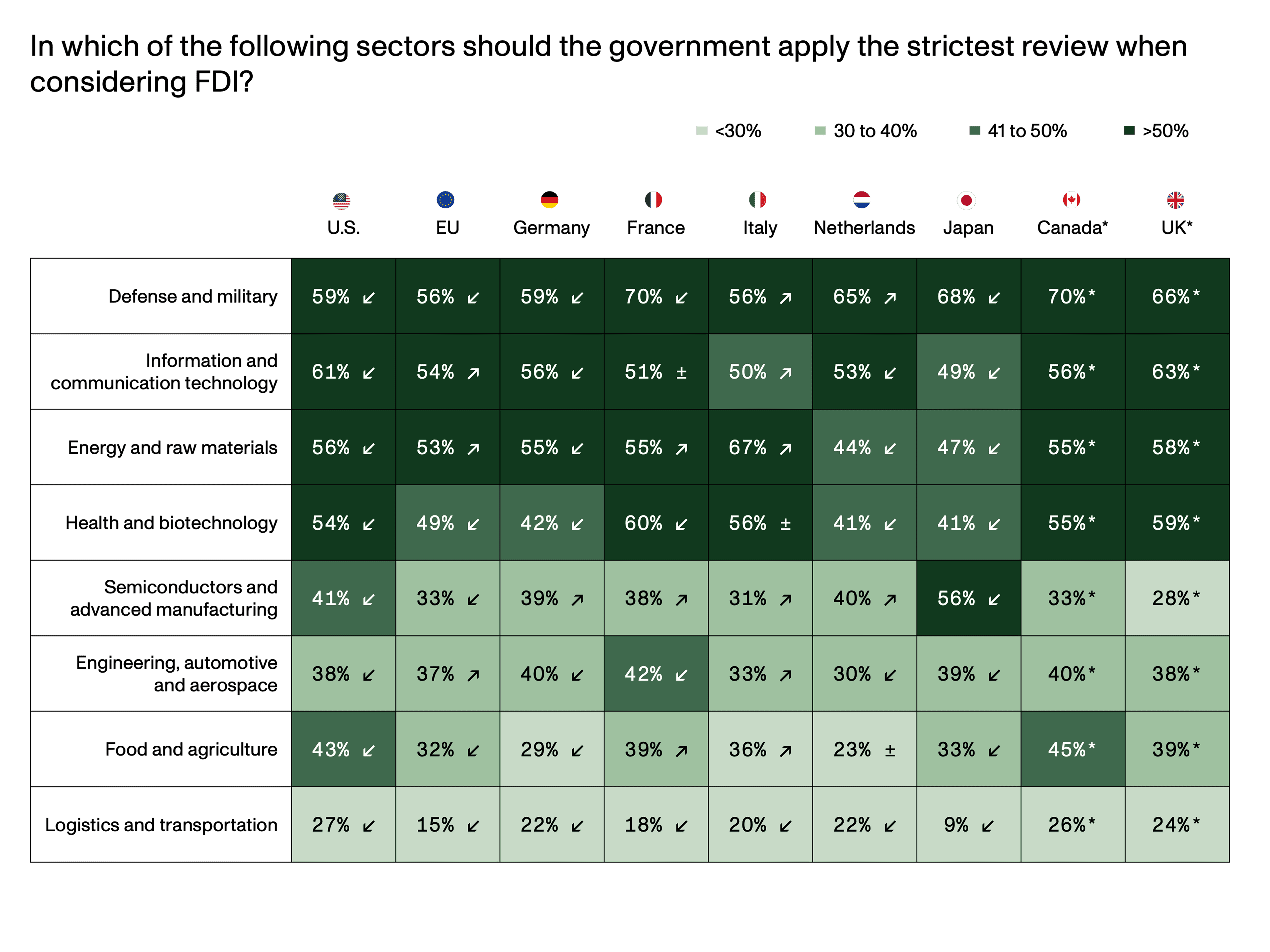
Defense remains the most sensitive sector, with ICT and energy and raw materials close behind

The latter two are seen as strategic: future competitiveness increasingly depends on control over data and digital infrastructure and recent geopolitical shocks have made secure access to energy and raw materials a question of economic resilience. However, as lines between national and economic security continue to blur, what counts as strategic or sensitive remains largely a political judgment that can vary by market and government priorities. Recent high-profile cases show that assets regarded as critical to security of supply can face intense scrutiny even outside traditionally sensitive sectors. Dealmakers who understand these second-order exposures and can credibly show how a transaction strengthens a company’s and country’s resilience can turn potential scrutiny into acceptance.

The latter two are seen as strategic: future competitiveness increasingly depends on control over data and digital infrastructure and recent geopolitical shocks have made secure access to energy and raw materials a question of economic resilience. However, as lines between national and economic security continue to blur, what counts as strategic or sensitive remains largely a political judgment that can vary by market and government priorities. Recent high-profile cases show that assets regarded as critical to security of supply can face intense scrutiny even outside traditionally sensitive sectors. Dealmakers who understand these second-order exposures and can credibly show how a transaction strengthens a company’s and country’s resilience can turn potential scrutiny into acceptance.

Large majorities expect geopolitical factors to shape review decisions

In an increasingly volatile geopolitical environment, a transaction’s risk profile can shift as rapidly as relations between the investor’s country of origin and the host government, and once in the spotlight, it risks being assessed largely regardless of its commercial merits. Dealmakers with a clear view of how that relationship is evolving and how exposed their sector and target are to it, are best positioned to mitigate risk and capture opportunity, including where growing geopolitical alignment can work in favor of the commercial case.

In an increasingly volatile geopolitical environment, a transaction’s risk profile can shift as rapidly as relations between the investor’s country of origin and the host government, and once in the spotlight, it risks being assessed largely regardless of its commercial merits. Dealmakers with a clear view of how that relationship is evolving and how exposed their sector and target are to it, are best positioned to mitigate risk and capture opportunity, including where growing geopolitical alignment can work in favor of the commercial case.

Confidence in governments’ ability to assess investment risk varies widely across markets

Lower public confidence can push authorities toward needing to build a more robust public case to justify their decisions, while higher confidence can imply entrenched positions that are harder to shift. Either way, investors who understand political agendas and dynamics, factor those into their deal communications strategy and engage relevant stakeholders early when needed can build credibility and strengthen the case for their transaction.

Lower public confidence can push authorities toward needing to build a more robust public case to justify their decisions, while higher confidence can imply entrenched positions that are harder to shift. Either way, investors who understand political agendas and dynamics, factor those into their deal communications strategy and engage relevant stakeholders early when needed can build credibility and strengthen the case for their transaction.


How we support you in getting the deal done

Our global team is uniquely placed to advise investors and companies to maneuver through opaque political and public scrutiny. We are the global leader in M&A communications and have advised on more than 3,900 transactions totaling $7.1 trillion in aggregate value over the past decade. Our global team of trusted advisors has operated at the highest levels of government and in international arenas. We know the players and understand the political and policy factors that can determine deal success. We work in close partnership with legal and financial advisors, helping companies and investors communicate their strategic deal rationales in ways that resonate with political agendas, regulatory requirements, and public sentiment.



Download the report

The full report – including further comparative findings, our recommendations for dealmakers and deep dives into the political-regulatory environment shaping foreign investment in nine markets – is available here.


Your contacts